

By Shannon Adcock, Guest Contributor
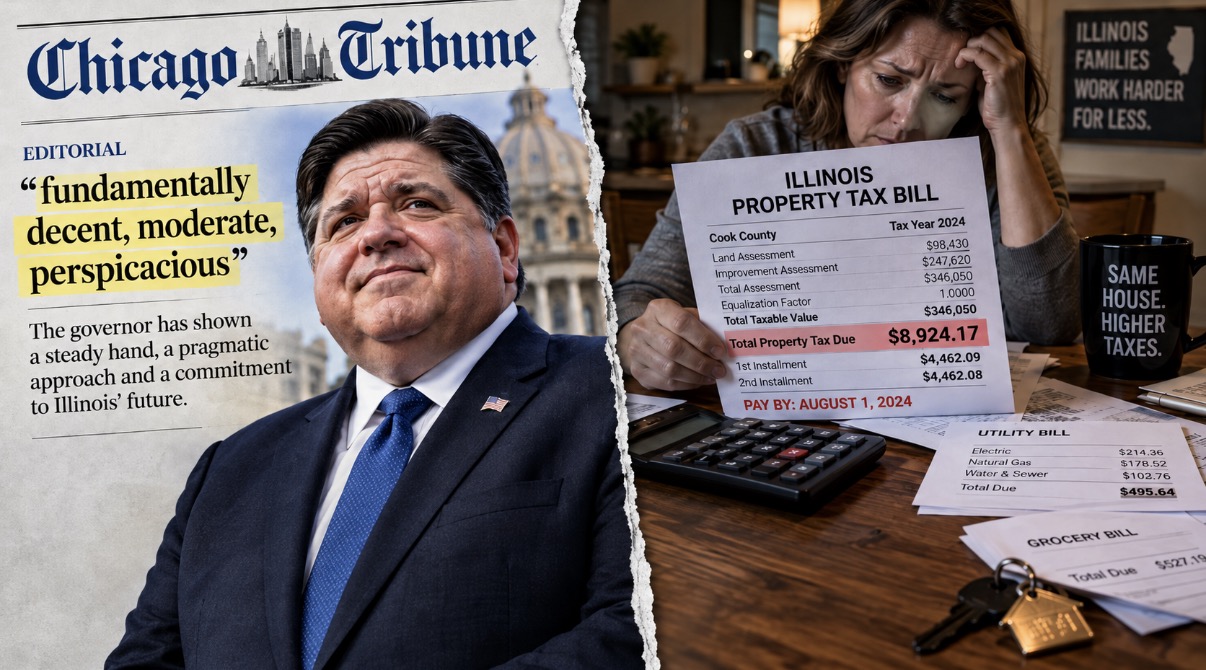
The Chicago Tribune editorial board just called Governor JB Pritzker a “fundamentally decent, moderate, perspicacious” leader with the potential to be transformative in a third term. They noted some fiscal concerns and his national ambitions, then framed the race against Darren Bailey as a choice between two honorable men.
From where I sit—as a mom who has spent years watching what this administration and its allies actually do to Illinois families—that description is unrecognizable.
I know the difference between red-state governance and what we have here because I lived it. My husband and I spent about a decade in Arizona when it was solidly red. We bought our first house there. We survived the 2008 real estate bust—20 percent down, and the value dropped by half within a year of ownership. It was brutal, but Arizona did not treat property ownership as a permanent extraction machine. We paid under $4k in annual property taxes on a four bedroom house and had our oldest in a wonderful public charter school. Fortunately, we recovered from the loss by purchasing a short sale in our neighborhood and flipping it.
We came back to Illinois, my roots, with our kids in 2015. Since then we have paid tens of thousands of dollars more in escalating property taxes each year than we would have faced in a place that did not fund the nation’s worst public pension systems off the backs of homeowners. That is not an abstract statistic. It is money that never went to our kids, our retirement, or anything else. It went to keep promises Illinois politicians made to government workers that the private-sector tax base cannot sustainably afford.
Illinois voters have been clear about what actually ranks highest. A September 2026 G Ratings survey of Illinois voters found the economy—including jobs, inflation, taxes, and property taxes—as the dominant concern at 40.1 percent. Crime came in a distant second at 13.8 percent, healthcare at 12.1 percent, and abortion access at just 5.5 percent. National Pew Research Center data from the same period shows the same pattern: the economy was “very important” to 84 percent of registered voters overall, while abortion sat at 46 percent and ranked behind healthcare, education, immigration, and crime for the broader electorate.
Property taxes in Illinois remain among the highest in the country, and the cumulative pressure shows up in the steady stream of people leaving. Census data show Illinois routinely loses tens of thousands of residents annually to other states—about 40,000 net in the most recent year—even as international migration props up the overall total.
The youngest cohorts are not immune. From 2020 to 2025, Illinois’ under-20 population fell 6.8 percent, more than three times the national rate, and growth among people in their 20s and 30s lagged the rest of the country. Analyses of young-adult moves, including LendingTree data, put Illinois among the states with net losses of Gen Z adults (a net loss of about 20,000 in 2024), with many heading to places offering lower costs and stronger private-sector opportunities. I do not need another poll to confirm the trend. I watch it in my own family and friend circle: people packing up, taking their tax dollars with them, and heading somewhere the cost of living does not feel like a permanent extraction. Pritzker’s years in office have accelerated that exit. Gen Z sees the numbers and the job market and is choosing better economic outcomes elsewhere. Good for them!
Yet much of the coverage and the progressive commentary treats two other priorities as if they represent the whole state: the interests of government workers (especially their pensions) and abortion.
They do not.
Public-sector unions and the pension systems attached to them are powerful. They are also a minority. Illinois carries the worst-funded public pensions in the country, with more than $140 billion in unfunded liabilities. Local property taxes exist in large part to keep those promises going. Pritzker signed a bill that added an estimated $11 billion to Chicago’s police and firefighter pension liabilities. That is real money that will show up on someone’s tax bill.
Government job growth has outpaced private-sector growth in recent years. These are legitimate concerns for the people who work in those systems. They are not the same as the concerns of the private-sector parents and taxpayers who make up most of the state and who are funding all of it.
Abortion is already a fundamental right under Illinois law. Pritzker has signed additional measures protecting records and expanding access. It is a core priority for the Democratic base and for the institutional left. It is not the top issue for most Illinois voters according to the polling that exists. Treating it as the central measure of whether a politician or a newspaper “stands with the people” erases everyone whose biggest daily problem is the property tax bill, the cost of living, or the condition of their kids’ schools.
I started Awake Illinois because I watched, in real time, how this machine uses children as leverage. School closures. Mandates. Curriculum fights. Title IX conflicts that put ideology ahead of girls’ sports and privacy. Teacher unions and their allies in Springfield treated parents who objected as the problem. That experience taught me how narrow the actual governing coalition is. It is heavy on public-sector interests, light on the broader electorate that pays the taxes and lives with the results. The media that covers this coalition as the default voice of Illinois simply repeats the same narrow focus.
Pritzker can be called moderate relative to the farthest left of his party. Relative to the cost of living, the pension trajectory, the population loss, and the priorities Illinois families actually name, the label does not hold. The Tribune’s framing treats the organized public-sector interest and abortion as the main story. For a lot of us who have watched the property tax bill climb year after year while loved ones leave, the main story is the tax burden and the slow drain of people who have decided they cannot afford to stay. Those are not the same electorate. I survived a real estate collapse in a red state. I did not expect to come home and pay for a permanent one created by policy.
Election Day is November 3. Pritzker’s base has probably already voted. The public-sector unions and the activists who treat abortion and government-worker priorities as the whole story will show up. The question is whether the rest of us—the parents, the homeowners, the taxpayers who are still here and still paying—will too.
Illinois does not change if we only complain. It changes if we vote.
Shannon Adcock is the founder and president of Awake Illinois, a grassroots nonprofit dedicated to parental rights, educational transparency, and protecting children from ideological agendas in public schools. A Naperville resident, wife, and mother of three, her activism began in 2020 when she fought for in-person learning and against divisive programs like critical race theory and gender ideology. As one of the lead plaintiffs in a major 2021 lawsuit involving over 700 parents against Governor J.B. Pritzker, the Illinois State Board of Education, and numerous school districts challenging unconstitutional mask and quarantine mandates—which secured a key injunction—she has also been profiled and featured in national media outlets, including discussions on parental rights and school policy battles. Now a bold voice for Illinois families, she has testified before state boards, filed numerous federal civil rights complaints, submitted to the Congressional record, and earned awards including the Titanium Backbone Award from Illinois Family Institute and the Never Surrender award from Defending Education. Her motto is “Be Uncancellable.”