


By Illinois Review
Illinois Republicans in Springfield are once again campaigning on an issue they cannot meaningfully fix: property taxes.
And while high taxes strain families across the state, the political reality remains unchanged — property taxes are controlled almost entirely at the local level, not by lawmakers in Springfield.
Hundreds of school boards, municipalities, park districts, fire districts, and independently elected assessors determine the overwhelming majority of every homeowner’s bill. State lawmakers cannot simply “lower property taxes” without overhauling the entire local-government funding structure — something that has proven politically impossible for decades because local officials fiercely guard their taxing authority.
And Republicans have no path to changing that. As of December 2025, Democrats hold a 78-40 supermajority in the Illinois House. Republicans have zero leverage, and even a Republican governor would be powerless — Democrats can override any veto with ease.
Despite these facts, some Republicans continue centering their messaging around property tax relief.
On November 25th, State Rep. Jed Davis — a principled conservative and strong patriot — posted a photo of himself “deep into legislative planning,” listing bills focused on transparency, housing affordability, assessment reform, and holding taxing bodies accountable. His stated mission: “Make Illinois affordable again for working families.”
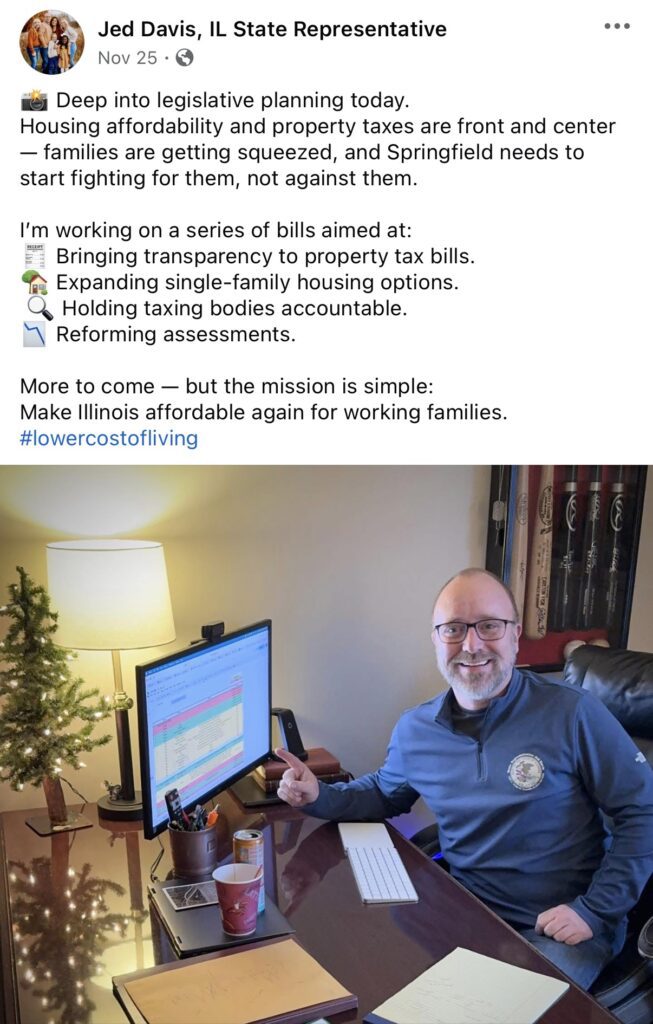
It’s a worthy goal. But there is little Davis can accomplish — not because of lack of effort, but because of political math. As a member of the House Freedom Caucus, Davis is someone Democrats routinely dismiss. In a chamber where they enjoy a supermajority, Democrats are not going to take cues from a Freedom Caucus Republican on property taxes or anything else. His proposals will be buried the moment they reach committee.
Fueling this renewed focus on property taxes is the Illinois Policy Institute, which recently published polling claiming the number one issue for voters is high taxes (52%), followed by the economy (26%), immigration (22%), and crime (21%).
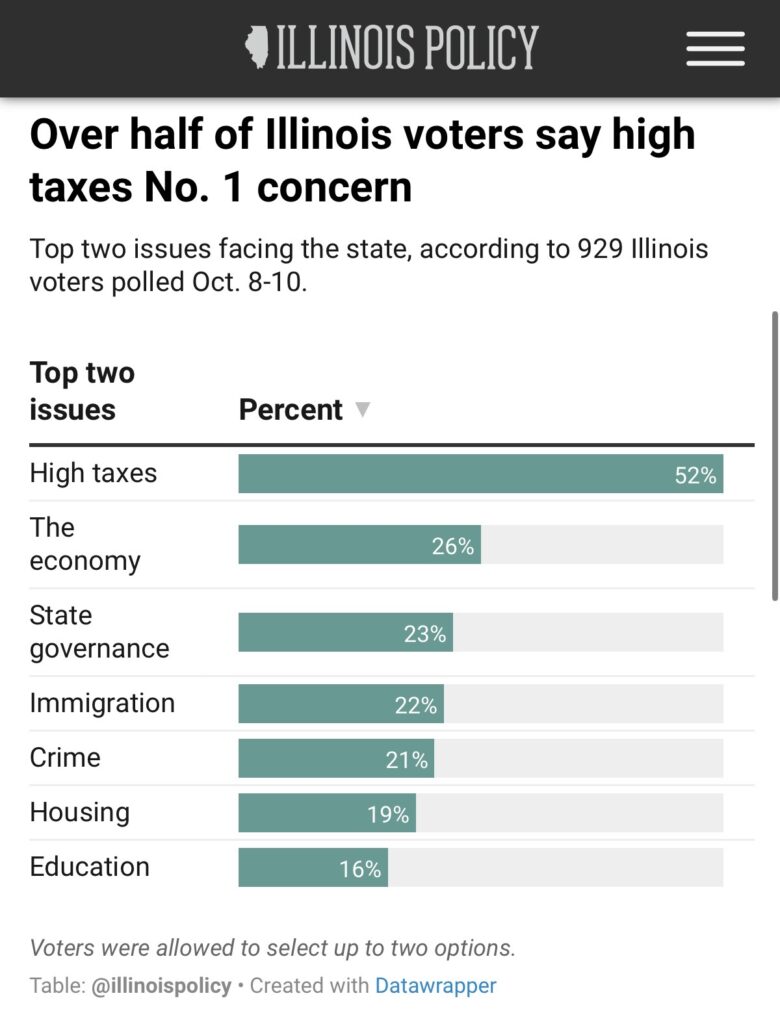
IPI is closely aligned with GOP gubernatorial candidate Ted Dabrowski, their former spokesman and vice president of policy, and the poll conveniently elevates his core campaign theme.
But historically, property taxes have not driven voter behavior. During the 2022 midterms, an Emerson College poll showed voters focused on the economy (35%), “threats to democracy” (17%), abortion (14%), and crime (10%). Taxes didn’t even appear as a standalone issue.
Illinois does have a high-tax problem — but the biggest reason businesses flee the state is crime. When Ken Griffin moved Citadel’s headquarters to Miami, he repeatedly cited violent crime, not taxes, as the number one reason. McDonald’s CEO Chris Kempczinski has echoed the same concerns.
Republicans must start prioritizing the issues that actually motivate voters. Property taxes may be a legitimate frustration — but they are a local issue Springfield cannot fix, no matter how many bills are drafted or how many polls are produced by politically aligned groups.
And here is the deeper problem: Illinois doesn’t just have a messaging issue — it has a turnout crisis.
Millions of Republican voters across this state simply do not vote. They are sick of a broken system, tired of empty promises, and unmoved by issues like property taxes that Springfield has no power to solve. High taxes and property taxes will not inspire these disillusioned Republicans to show up in 2026. Even worse, it continues to erode voter trust in party leadership and messaging.
Crime, safety, immigration, corruption, and moral issues will.
If Illinois Republicans want to win again, they must focus on the issues that actually drive voter turnout — not on issues they cannot meaningfully control.