
By Illinois Review
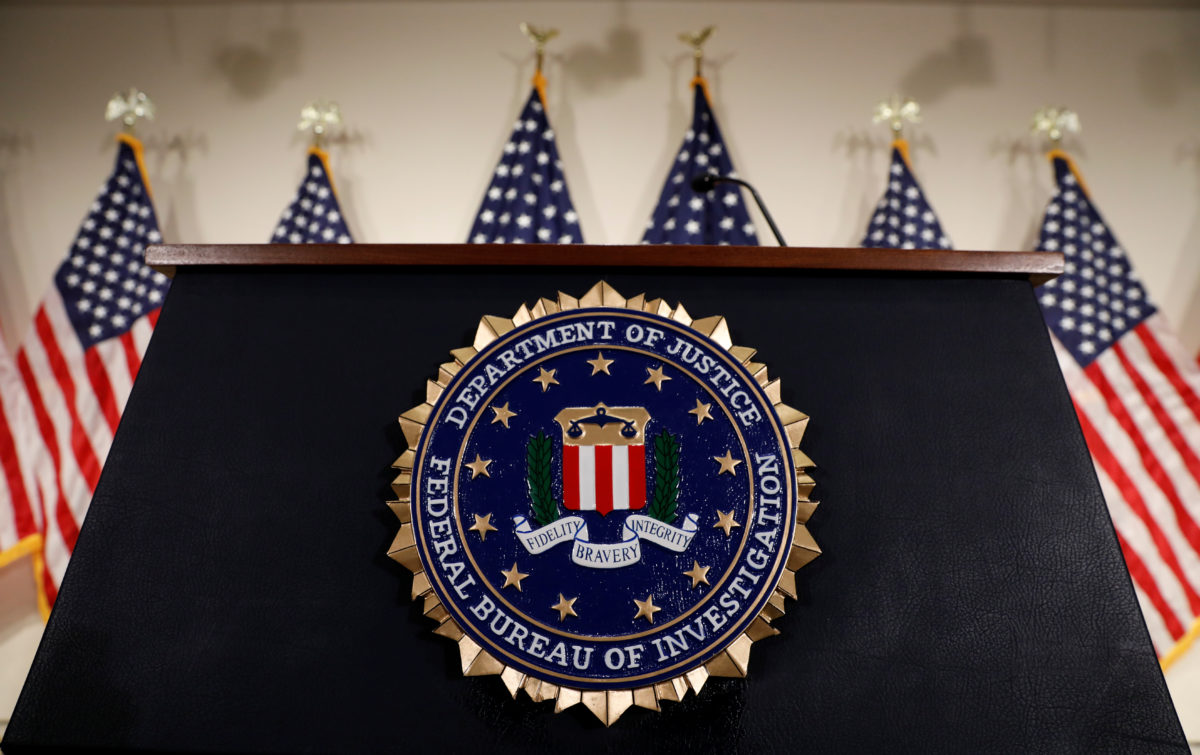
Less than a month after Illinois Review exposed what appeared to be a fraudulent political mailing targeting the Darren Bailey gubernatorial campaign, the Federal Bureau of Investigation has formally confirmed the matter has been routed for review.
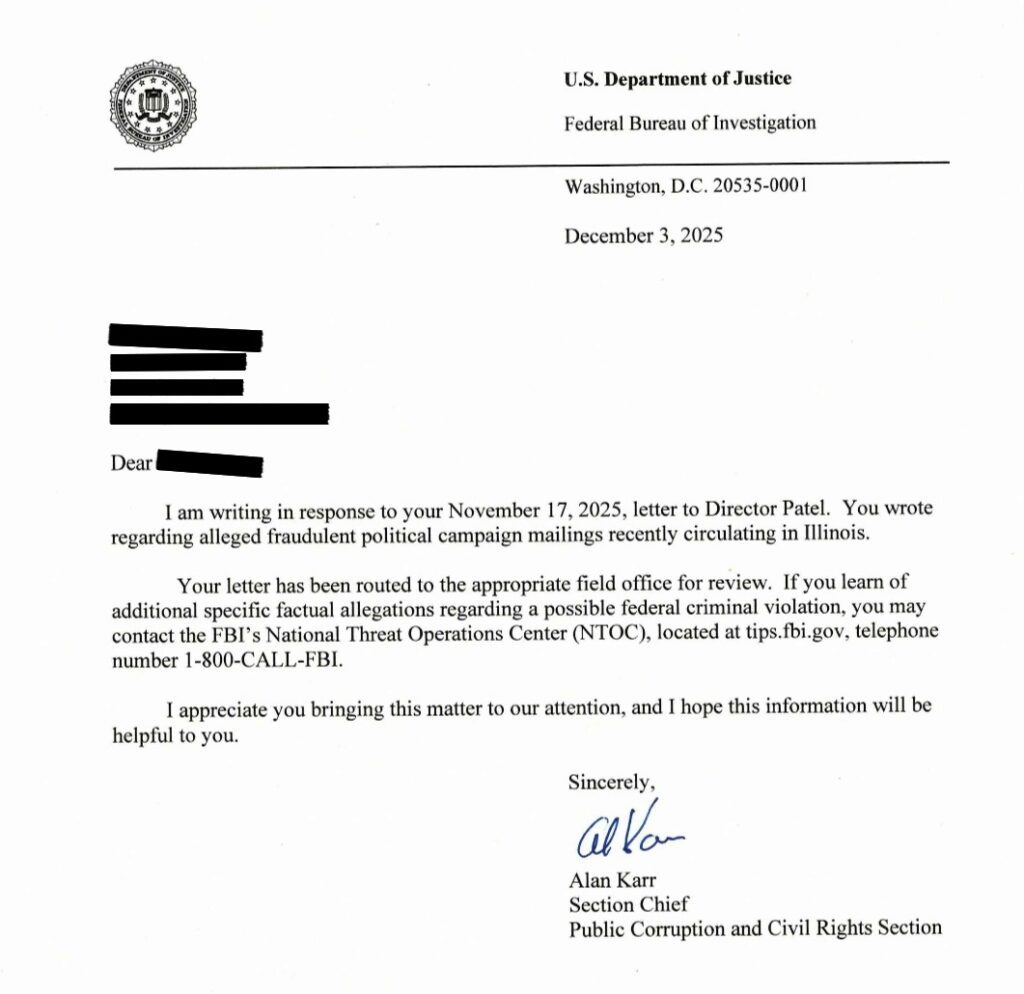
In a December 3, 2025 letter, FBI Section Chief for Public Corruption and Civil Rights Alan Karr responded to a concerned citizen who contacted the Bureau after reading Illinois Review’s November 16 report.
The letter was addressed to FBI Director Kash Patel and acknowledged allegations involving “fraudulent political campaign mailings recently circulating in Illinois.”
Karr wrote that the complaint had been sent to the appropriate FBI field office for review and invited the submission of additional factual allegations through the FBI’s National Threat Operations Center.
That confirmation matters.
It shows the original Illinois Review reporting did not disappear into the void. It caught the attention of federal authorities and prompted formal review by the nation’s top law enforcement agency.
In plain terms, the matter is now under federal scrutiny.
Predictably, critics will claim this is a waste of taxpayer resources. But Illinois remains the corruption capital of America. From politicians sent to prison to decades of pay-to-play politics, Illinois voters have every reason to demand scrutiny when something looks wrong – especially in a Republican primary where election integrity is routinely promised but too often ignored.
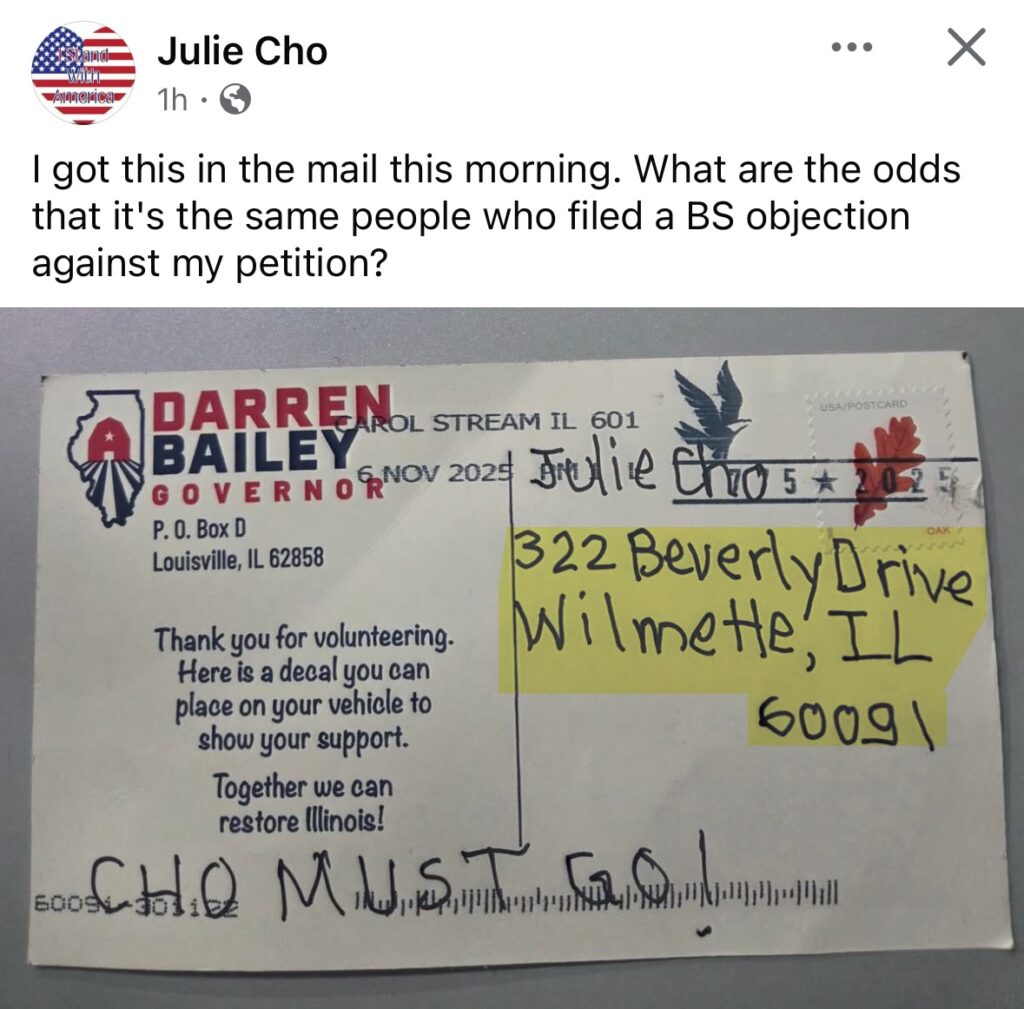
At the center of the controversy is a 2022-era “Darren Bailey for Governor” postcard mailed to political activist Julie Cho. The postcard featured outdated campaign branding and a handwritten political message reading, “Cho Must Go.”
The Bailey campaign has unequivocally denied any involvement.
Multiple inconsistencies immediately raised red flags, including the use of an obsolete 2022 logo, crude handwritten messaging, and the suspicious timing of the mailing. Anyone connected to Darren Bailey’s current campaign would know the branding changed years ago.
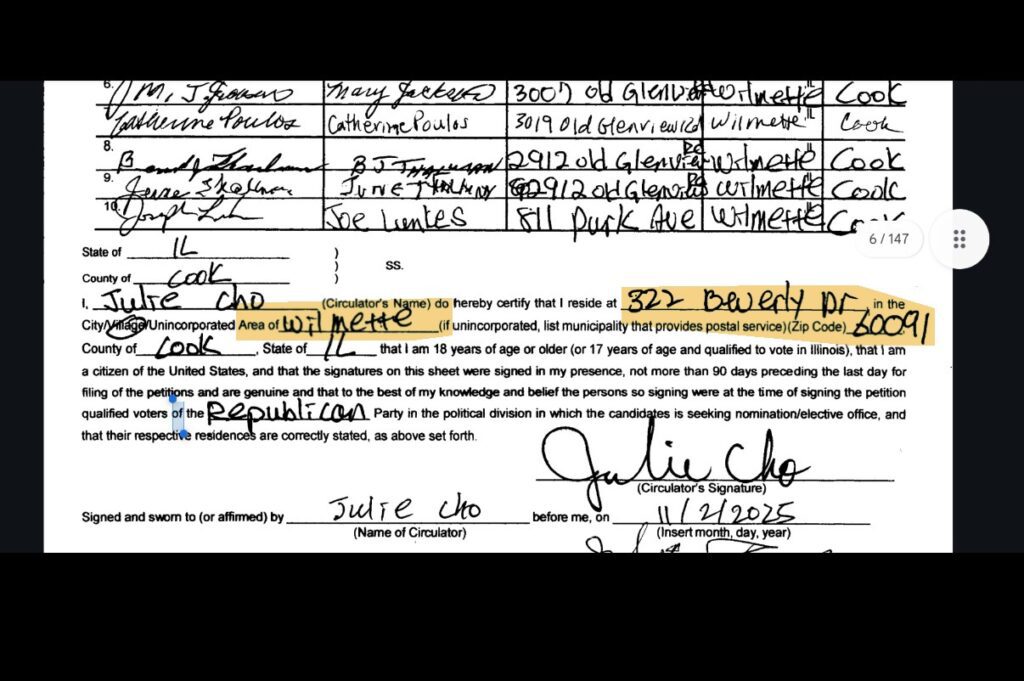
Second, while no one is accusing Cho of fabricating anything, observers quickly noticed that the handwriting on the postcard closely resembles the handwriting on Cho’s own nomination petitions.
No accusations are being made – just an unavoidable comparison that raises serious questions about the postcard’s origins and why it surfaced at this precise moment in the primary.
The mailing surfaced while Darren Bailey and his wife Cindy were mourning the loss of their son, daughter-in-law, and grandchildren in a tragic helicopter crash – making the timing not only suspect, but morally disturbing.
This incident is not occurring in a vacuum. The Republican primary for Illinois governor is already getting dirty.
The postcard controversy fits a broader pattern of political hardball already shaping the GOP primary.
In October 2025, Ted Dabrowski’s top advisor, former State Rep. Jeanne Ives – who previously served as a senior strategist on Bailey’s 2022 campaign – leaked a confidential internal document from that race. The leak appeared designed to damage Bailey just as the 2026 primary season was beginning.
That episode raised serious ethical and potential legal concerns, exposing the lengths to which campaign operatives are willing to go to tarnish a competitor’s reputation. Combined with the postcard incident, it paints a troubling picture of political gamesmanship overtaking basic standards of integrity.
Democrats like JB Pritzker routinely benefit when Republicans undercut each other with dirty tricks, distractions, and ethical lapses. That reality makes it even more important for Republicans to police their own primaries – and for law enforcement to examine credible allegations of fraud when they arise.
Election integrity is not a slogan. It is a standard.
If Republicans are serious about restoring trust in Illinois elections, they cannot dismiss credible concerns simply because they are uncomfortable or politically inconvenient. The FBI’s response confirms what Illinois Review readers already knew: this issue is serious enough to warrant review.
The March 17, 2026 primary is fast approaching. Voters deserve transparency, accountability, and campaigns that win on ideas – not deception and dirty tricks.