

By Illinois Review
The so-called “Pritzker Rescue Bill” cleared committee this week on a 13–7 party-line vote, but not without unified Republican opposition.
All seven Republican members of the House committee voted NO on the measure, which begins the process of granting long-term tax relief to the Chicago Bears organization as Democrats scramble to keep the team from moving to Indiana.
The bill would allow a 20-year freeze on property tax assessments for large “mega-projects,” including a potential new NFL stadium in Arlington Heights. Instead of paying standard property taxes based on rising assessed values, the Bears would negotiate a “special payment” – commonly known as a PILOT agreement – directly with local government.
Democrats argue the proposal creates certainty and levels the playing field against Indiana’s aggressive incentive package. But critics say it is nothing more than a last-minute bailout for failed leadership.
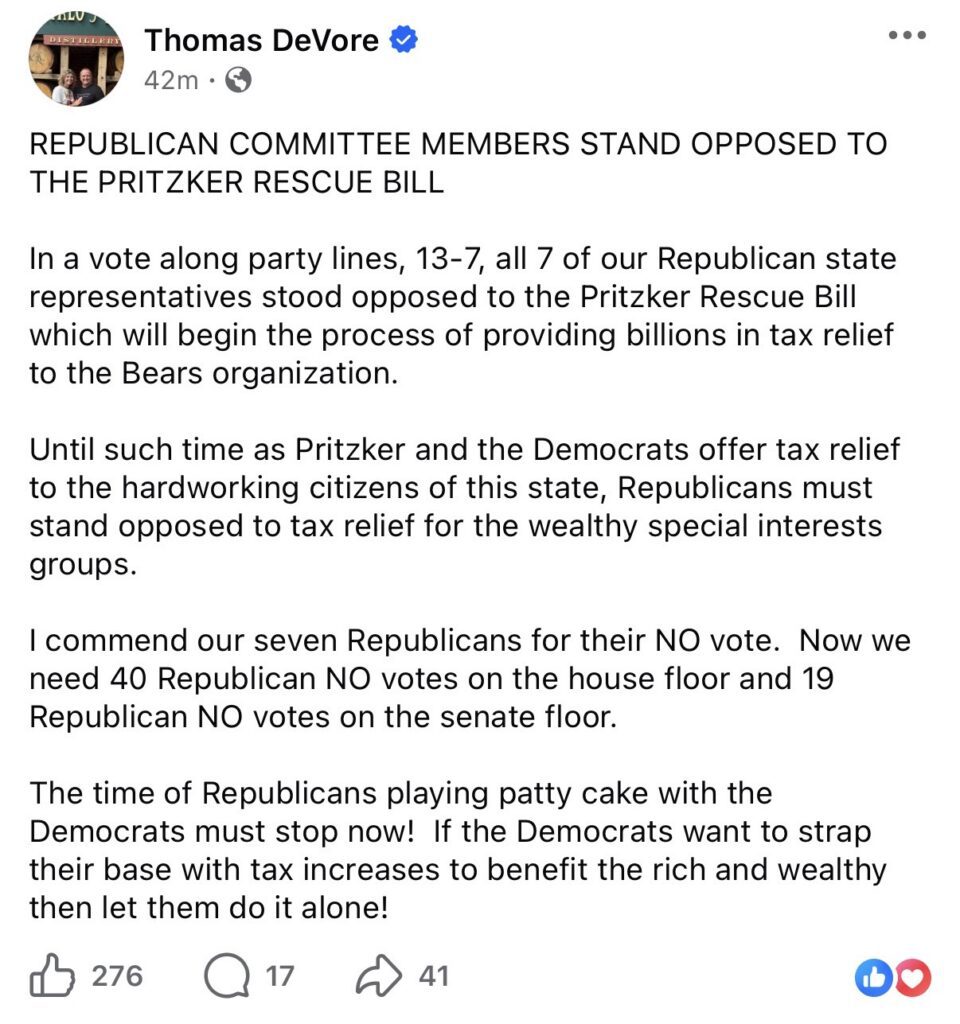
Former attorney general candidate Tom DeVore posted on Facebook following the vote.
“REPUBLICAN COMMITTEE MEMBERS STAND OPPOSED TO THE PRITZKER RESCUE BILL,” DeVore wrote. “In a vote along party lines, 13-7, all 7 of our Republican state representatives stood opposed to the Pritzker Rescue Bill which will begin the process of providing billions in tax relief to the Bears organization.”
The seven House Republicans who voted against the measure are: State Representatives Joe Sosnowski, Amy Elik, Martin McLaughlin, Kyle Moore, Steven Reick, Jennifer Sanalitro and Travis Weaver.
Their unified stand sends a clear signal ahead of an expected floor vote. Now the pressure shifts to the full House.
If Democrats want to move forward with billions in long-term tax relief for a professional sports franchise while everyday Illinois families continue to shoulder some of the highest property taxes in the nation, they can do so with their own votes.
Republicans have drawn a line.
For over a year, Democrat leaders ignored the Bears, criticized their proposal, and made clear the project was not a priority. Only after Indiana aggressively courted the team did Springfield suddenly discover a sense of urgency. What changed was not policy – it was panic.
The question now is whether Republicans will remain united or provide bipartisan cover for what many see as a bailout designed to protect Gov. JB Pritzker and the Democrat supermajority from the consequences of their own delay.
Illinois taxpayers are watching.