

By Illinois Review
Newly uncovered attendance records are raising serious concerns about Illinois State Senator Jason Plummer’s leadership, after data shows he missed more legislative workdays than any other Republican in the Senate – by a wide margin.
The findings, obtained through a FOIA request from attorney Tom DeVore, reveal that Plummer was absent for more than 35 percent of legislative days in Springfield over a two-year period in 2024 and 2025.
In raw numbers, the gap is striking. While the average Republican state senator missed fewer than four days during that time, Plummer missed 34 days – more than nine times higher than his colleagues.
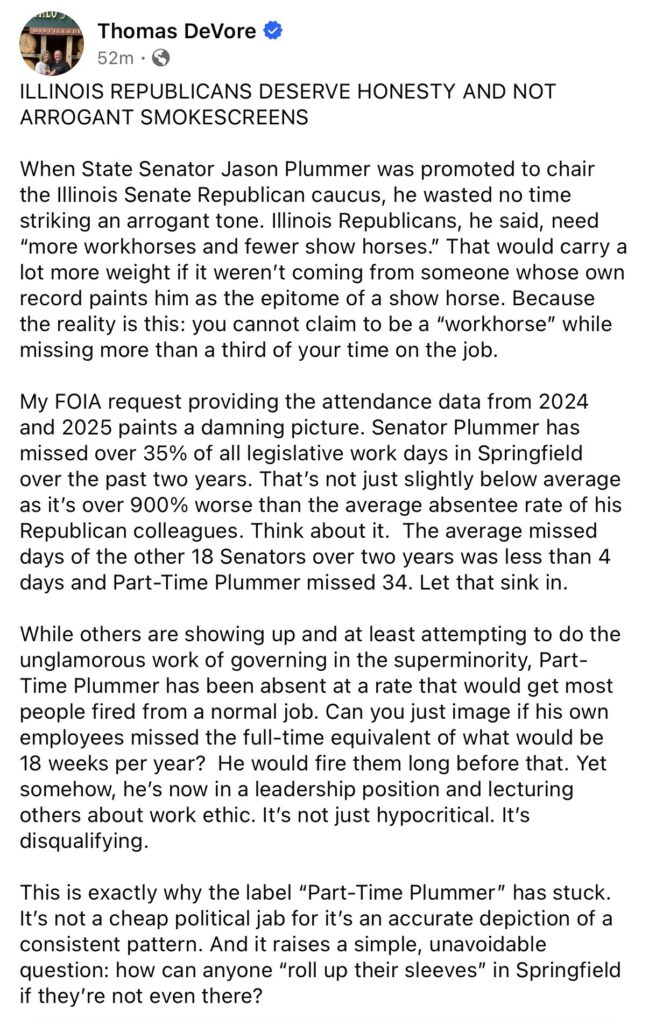
The comparison becomes even more troubling when translated into a full-time work schedule. Based on standard employment expectations, that level of absenteeism is roughly equivalent to missing 18 weeks of work per year – a rate that would likely result in termination in most professions.
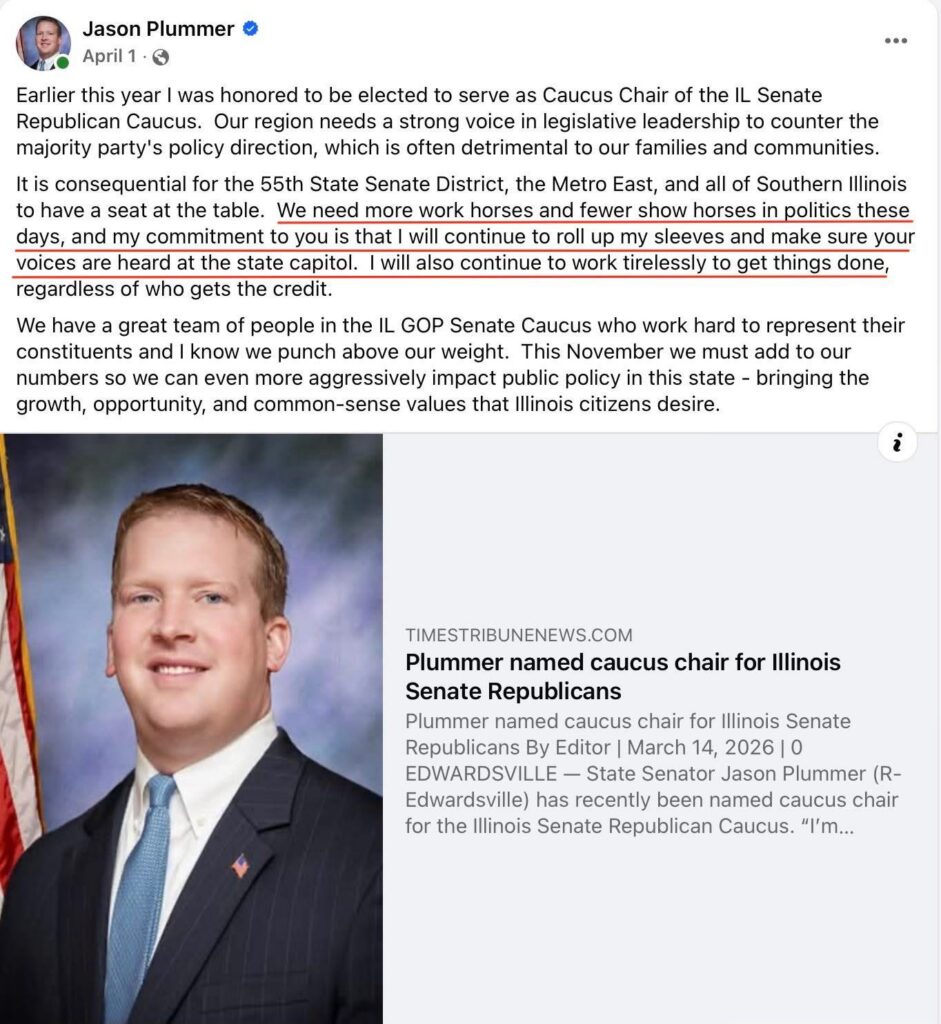
The revelations come at a particularly sensitive time, as Plummer was recently promoted to chair the Illinois Senate Republican caucus – a leadership role that demands visibility, consistency, and accountability.

Critics say the numbers paint a picture that directly conflicts with the message Plummer has publicly promoted. Upon taking his leadership position, he called for Republicans to become “workhorses” rather than “show horses,” a remark now drawing renewed scrutiny in light of his attendance record.
The contrast has fueled frustration among grassroots Republicans and political observers who argue that leadership starts with showing up – especially in a state where Republicans already face long odds against a Democrat supermajority.
In Springfield, where Republicans operate in the super minority, every vote, committee hearing, and floor debate carries added weight. Absences not only weaken the party’s ability to push back against Democratic policies, but also send a message to voters about priorities and commitment.
The issue also underscores a broader challenge for Illinois Republicans as they attempt to rebuild credibility with voters. At a time when taxpayers are demanding accountability and results, critics argue that internal standards must match the rhetoric often directed at Democratic leadership in Chicago and across the state.
Gov. JB Pritzker and Democratic lawmakers have long been criticized by conservatives for policies tied to rising crime, government spending, and declining public trust. But some Republicans now warn that failing to hold their own leaders accountable risks undermining that argument.
The label “Part-Time Plummer” has begun circulating among activists and political insiders, reflecting what some see as a pattern that is difficult to ignore.
Supporters of stronger internal accountability argue that leadership is not defined by messaging or social media presence, but by consistent participation and engagement in the legislative process.
So far, Senator Plummer has not publicly addressed the attendance data or responded to the criticism surrounding it.
For voters, donors, and party leaders alike, the situation presents a simple but pressing question: can someone who misses more than a third of their legislative responsibilities effectively lead a caucus tasked with challenging one of the most powerful Democratic machines in the country?
As pressure builds, many Republicans say the answer will depend on whether accountability comes next.