


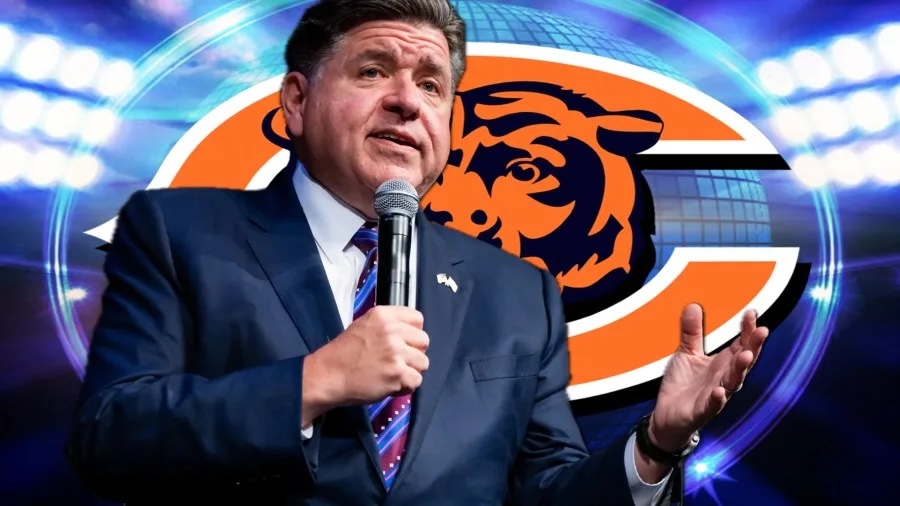
By Illinois Review
Many Illinois politicians continue to insist that the Chicago Bears’ discussions with Indiana are merely a negotiating tactic.
They’re wrong.
After years of watching the stadium saga unfold, Illinois Review believes the evidence increasingly points to a conclusion many in Springfield refuse to acknowledge: the Bears are preparing to leave Illinois because Indiana offers something Illinois no longer can – a competitive business environment and a government willing to move at the speed of business.
For years, the Bears pursued a long-term solution in Illinois. They purchased Arlington Park, developed plans for a multi-billion-dollar stadium and mixed-use development, and repeatedly sought certainty regarding taxes, infrastructure, and government support.
Instead, they encountered delays, political infighting, and legislative paralysis.
The Illinois General Assembly recently adjourned without passing meaningful legislation that would have provided the Bears with the long-term certainty they sought. After years of discussions, negotiations, studies, and public debate, the franchise remains without a clear path forward in its home state.
Meanwhile, Indiana leaders have spent the last six months aggressively pursuing the Bears and building a compelling case for why the franchise should move across the state line.
The contrast between the two states has become impossible to ignore.
Indiana consistently ranks among the most business-friendly states in America. CNBC recently ranked Indiana ninth overall in its annual “Top States for Business” rankings, including third for cost of doing business, fifth for business friendliness, sixth for infrastructure, and second for cost of living.
Forbes ranked Indiana as the second-best state in America to start a business, while the Tax Foundation ranked Indiana tenth nationally for tax competitiveness.
Illinois, meanwhile, ranks near the bottom in many of the same categories.
CNBC ranked Illinois 38th for business friendliness, 34th for cost of living, and 44th for economic performance.
The Tax Foundation’s 2026 State Tax Competitiveness Index placed Illinois 38th overall, including 42nd for corporate taxes and 41st for property taxes.
Chief Executive magazine ranked Illinois 48th in its annual survey of CEOs, placing it among the least attractive states in America for business investment.
Those rankings are not merely statistics.
They help explain why Indiana has experienced net gains in both population and businesses while Illinois continues to struggle with outmigration and business departures.
Since 2021, Indiana has consistently added residents, jobs, and business investment. New business formations have outpaced closures, and economic development officials have documented dozens of companies relocating operations from neighboring states, including Illinois.
Illinois has experienced the opposite trend.
More than 500,000 residents have left Illinois in recent years, while businesses continue relocating to neighboring states in search of lower taxes, reduced regulatory burdens, and greater economic certainty.
The Bears are undoubtedly aware of these trends.
This decision is about far more than where to build a football stadium. It is about where one of the NFL’s founding franchises believes it can invest billions of dollars and position itself for long-term success.
Indiana Governor Mike Braun has repeatedly expressed confidence that Indiana remains in a strong position and has indicated that a favorable outcome for the state could be coming soon.
Indiana lawmakers have already approved legislation supporting a professional sports stadium project in Northwest Indiana, while state and local officials have explored ways to help the Bears exit their Soldier Field lease years ahead of schedule.
Those are not the actions of a state making a symbolic pitch. They are the actions of a state actively preparing to welcome one of the most recognizable franchises in professional sports.
For years, Illinois Democrats assumed the Bears had nowhere else to go.
That assumption may prove extraordinarily costly.
The Bears have spent years asking Illinois leaders for certainty. Instead, they received delays, political dysfunction, and competing agendas.
Indiana offered a clear path forward, a stronger business climate, and leaders eager to compete for one of the largest economic development opportunities in the Midwest.
This is no longer a bluff.
It is no longer a negotiating tactic.
It is a business decision.
The Bears gave Illinois years to find a solution. Instead, they received delays, uncertainty, and political dysfunction.
Indiana offered something different: certainty.
Unless Illinois leaders suddenly reverse years of inaction, the Chicago Bears appear poised to join the growing list of residents, employers, and businesses that have concluded their future is brighter across the Indiana state line.