

By Illinois Review
For decades, California has served as the Democratic Party’s political laboratory – a state where progressive policies dominated elections and Republicans struggled to remain relevant statewide.
This week’s primary results suggest that may be beginning to change.
While California remains firmly Democratic, Republicans posted surprisingly strong performances in both the governor’s race and the Los Angeles mayoral contest, signaling growing voter frustration with progressive governance and offering a potential roadmap for Republicans in blue states like Illinois.
For Illinois Republicans, the results are particularly noteworthy. California and Illinois share many of the same challenges fueling voter dissatisfaction: rising costs of living, public safety concerns, high taxes, business flight, and growing frustration with one-party Democratic rule.
In the race to replace term-limited Governor Gavin Newsom, Republican businessman and former Fox News host Steve Hilton emerged as one of the top vote-getters under California’s unique top-two primary system.
With roughly 55 to 60 percent of votes counted, Hilton was leading or tied with former Biden administration official Xavier Becerra, each receiving approximately 25 to 28 percent of the vote.
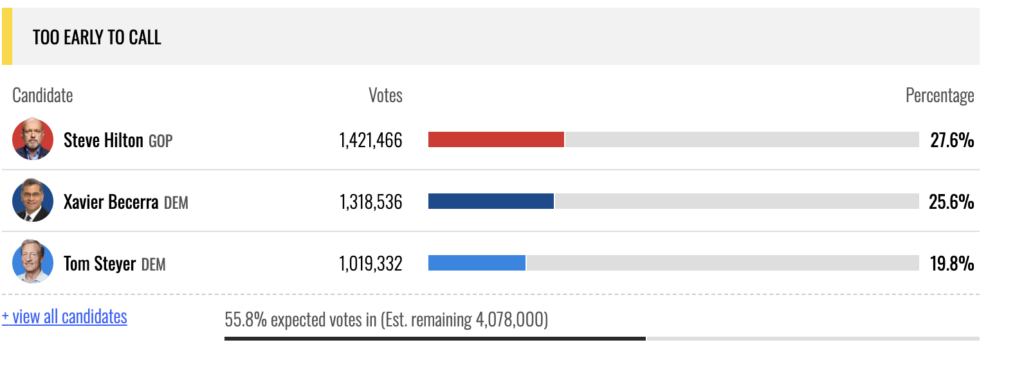
Democrat Tom Steyer trailed behind, while Republican Chad Bianco also posted a respectable showing.
Under California law, the top two finishers advance to the general election regardless of party affiliation. Hilton’s strong performance means Republicans are positioned to compete seriously in a statewide race for the first time in years.
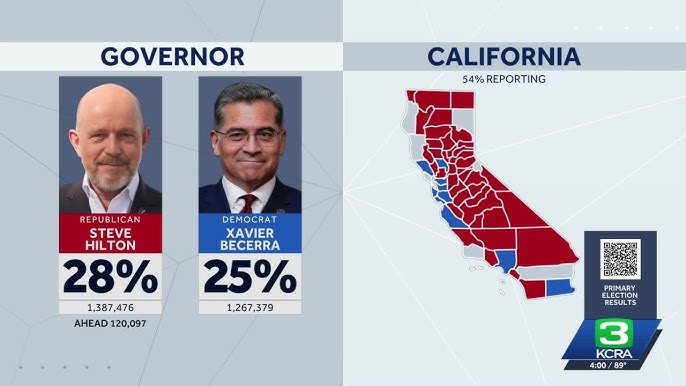
California has not elected a Republican governor since Arnold Schwarzenegger left office in 2011. While Democrats remain favored heading into November, Hilton’s emergence demonstrates that Republican candidates can still gain traction when focused on issues voters encounter every day.
A similar story unfolded in Los Angeles.
Incumbent Mayor Karen Bass led the nonpartisan primary with roughly 35 percent of the vote. However, political newcomer and reality television personality Spencer Pratt delivered one of the night’s biggest surprises, capturing approximately 30 percent of the vote and earning a likely spot in the November runoff despite Republicans making up less than 15 percent of Los Angeles voters.
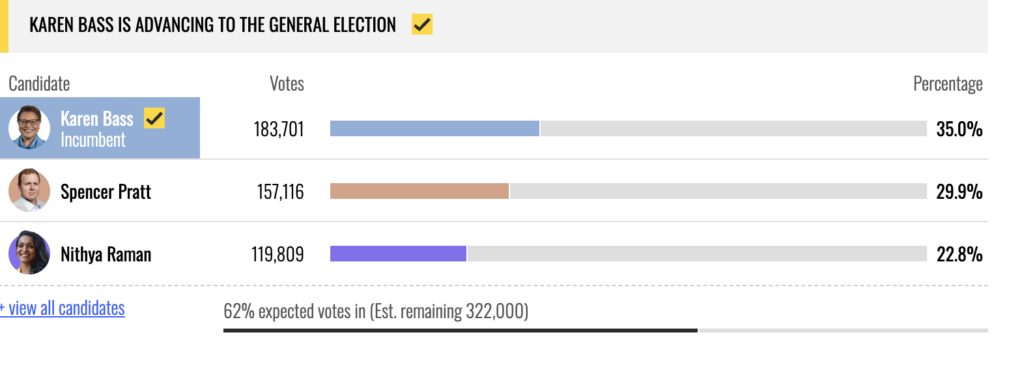
Pratt’s campaign gained momentum after he became a vocal critic of city leadership following the devastating wildfires that destroyed his family’s home. He focused heavily on homelessness, crime, public safety, and the city’s recovery efforts – issues that continue to frustrate many Los Angeles residents.
Meanwhile, progressive City Council member Nithya Raman finished well behind both Bass and Pratt.
Taken together, the results suggest that voters are increasingly willing to challenge progressive orthodoxy when confronted with rising costs of living, public safety concerns, homelessness, and declining confidence in government institutions.
The message extends far beyond California.
Democratic leaders in Illinois, California, New York, and other traditionally blue strongholds have long argued that progressive policies represent the future of American politics.
California remains a Democratic state, and mail-in ballots could still alter final margins in the days ahead. Democrats continue to hold overwhelming advantages in voter registration and legislative control.
But the strong Republican performances this week reveal something many political observers have long dismissed: even in America’s deepest blue states, voters are increasingly willing to challenge progressive leadership when they believe the government is failing to deliver results.
For Illinois Democrats, the warning signs emerging from California may be impossible to ignore. Voters in one of America’s most progressive states are increasingly questioning whether rising costs, public safety concerns, homelessness, and one-party rule are producing the results they were promised.
If those frustrations continue to grow, California may be offering Illinois a glimpse of its political future.