

By Illinois Review
The Chicago Bears’ stadium standoff has officially crossed from sports drama into a political reckoning for Illinois Democrats.
This week, Bears President and CEO Kevin Warren confirmed the team is expanding its search for a new domed stadium beyond Arlington Heights to include Northwest Indiana.
That move alone is a stunning rebuke of Gov. JB Pritzker, Chicago Mayor Brandon Johnson, and Democratic lawmakers who continue to claim Illinois is economically strong, business-friendly, and competitive.
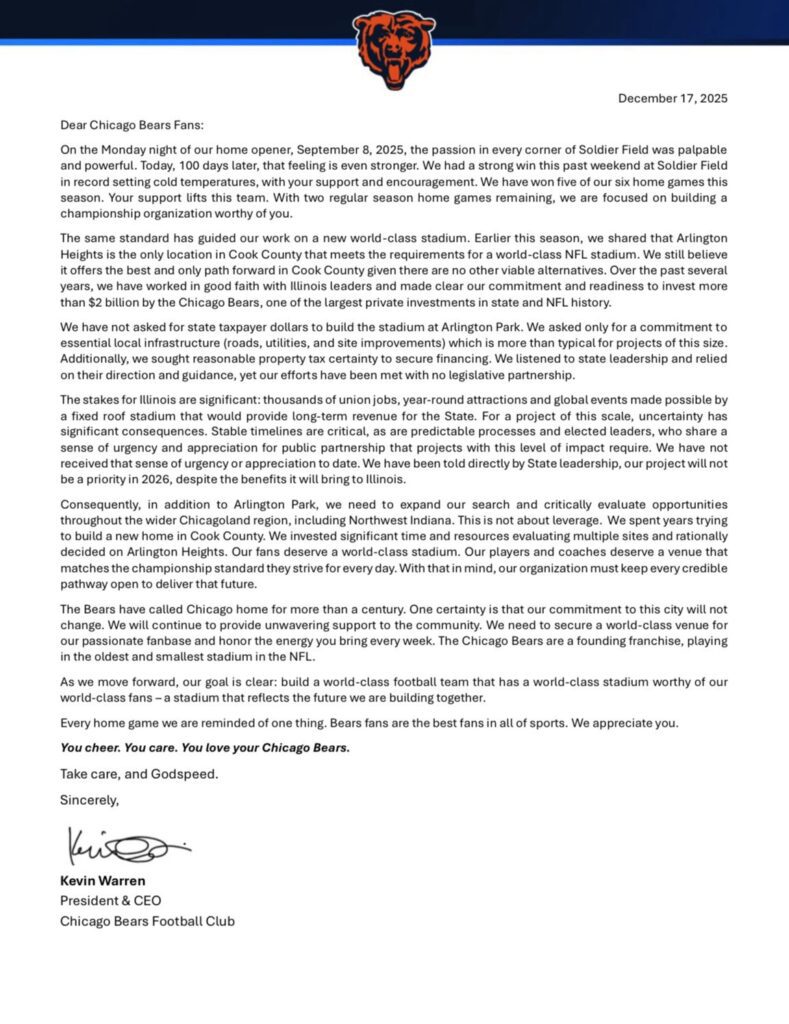
The Bears purchased the former Arlington Park racetrack in 2023 with hopes of building a world-class, fixed-roof stadium capable of hosting Super Bowls and major events. But in an open letter to fans and interviews with the Chicago Tribune, Warren made clear that Illinois leaders have failed to deliver – despite years of promises.
Infrastructure funding remains unresolved. Long-term property tax certainty is still in limbo. Worse, state leaders reportedly told the team the project would not be a priority in 2026.
“We are at a pivotal juncture,” Warren warned, stressing that delays have consequences.
While Arlington Heights remains the Bears’ preferred Cook County site, Warren said “everything is back on the table,” including Northwest Indiana.
Indiana leaders immediately welcomed the Bears. Republican Gov. Mike Braun praised Indiana’s pro-business climate and pledged to work aggressively to land the project. The state even created a Northwest Indiana Professional Sports Development Commission earlier this year specifically to attract a major franchise.
Indiana’s confidence is backed by hard data.
In 2025 rankings, Indiana consistently outperforms Illinois as a place to do business. CNBC ranks Indiana #9 among Top States for Business, compared to Illinois at #13.
The ALEC-Laffer Rich States, Poor States economic outlook places Indiana at #3 nationwide – while Illinois languishes at #46.
The Tax Foundation ranks Indiana #10 for state tax competitiveness; Illinois falls to #37.
The tax gap is even more telling. Indiana’s corporate income tax stands at 4.9 percent. Illinois’ corporate rate is 9.5 percent – second highest in the nation once the replacement tax is included.
Indiana’s property taxes average around 0.77 percent and are capped by law. Illinois property taxes are among the highest in the country, especially for commercial projects.
Indiana also offers lower workers’ compensation costs, cheaper unemployment insurance, and lower unit labor costs.
That reality explains why Indiana continues to attract investment – and why Illinois continues to lose it.
Back in Springfield, Democrats responded with denial. Pritzker’s spokesman called the Indiana talks a “slap in the face” to fans and insisted taxpayers should not bear the cost of private development.
But that ignores the central issue: Democratic lawmakers have refused to pass legislation allowing long-term property tax agreements that would cost the state nothing while providing certainty for major projects.
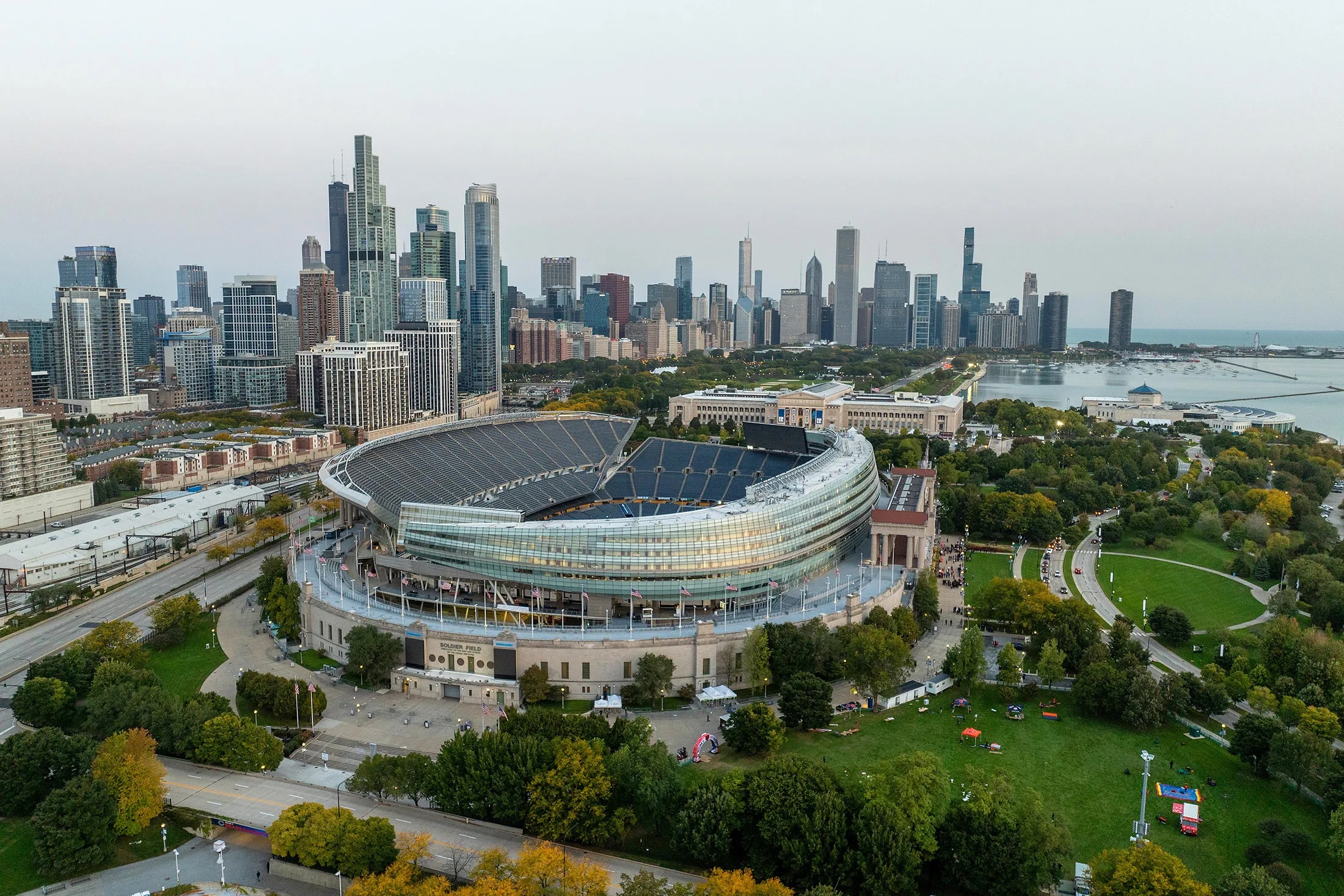
The Bears are still under lease at Soldier Field until 2033. No final decision has been made. But the warning is unmistakable.
Because of Democratic failure – led by JB Pritzker – the Chicago Bears could ultimately build their future in Indiana, taking billions in investment and decades of economic activity with them.
That would be more than a stadium loss. It would be a devastating symbol of Illinois’ declining competitiveness under one-party rule.