

By Illinois Review
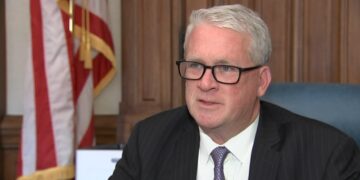
Ted Dabrowski’s campaign for Illinois governor is already facing serious legal exposure after launching a prerecorded robocall that appears to violate federal law – and the political irony surrounding the mistake is impossible to ignore.
Illinois voters report receiving a robocall on their mobile phones on Tuesday in which Dabrowski personally identifies himself, saying he is “a conservative Republican running for governor against JB Pritzker,” before the message ends with “paid for by Ted for Illinois.”
That disclosure may satisfy part of Illinois’ Election Code, but it does not cure the far more serious issue: political robocalls to cell phones without prior express consent are illegal under federal law.
The federal Telephone Consumer Protection Act (TCPA) strictly prohibits prerecorded or autodialed political calls to mobile phones unless the recipient has explicitly opted in. The rule applies nationwide, including Illinois, and includes artificial and AI-generated voices – a point reinforced by the FCC in 2024.
Campaigns remain exempt from the National Do Not Call Registry, but they are not exempt from TCPA consent requirements for cell phones.
Each illegal call carries $500 in statutory damages, rising to $1,500 per call if the violation is deemed willful or knowing. With mass dialing, liability can quickly balloon into seven figures.
Class action lawsuits are common, and the FCC can impose additional administrative fines that often start in the tens of thousands of dollars per violation.
Illinois has already learned this lesson the hard way.
In Garvey v. Citizens for Rauner, a class-action TCPA lawsuit, former Governor Bruce Rauner’s campaign committee agreed to a $1 million settlement in 2021.
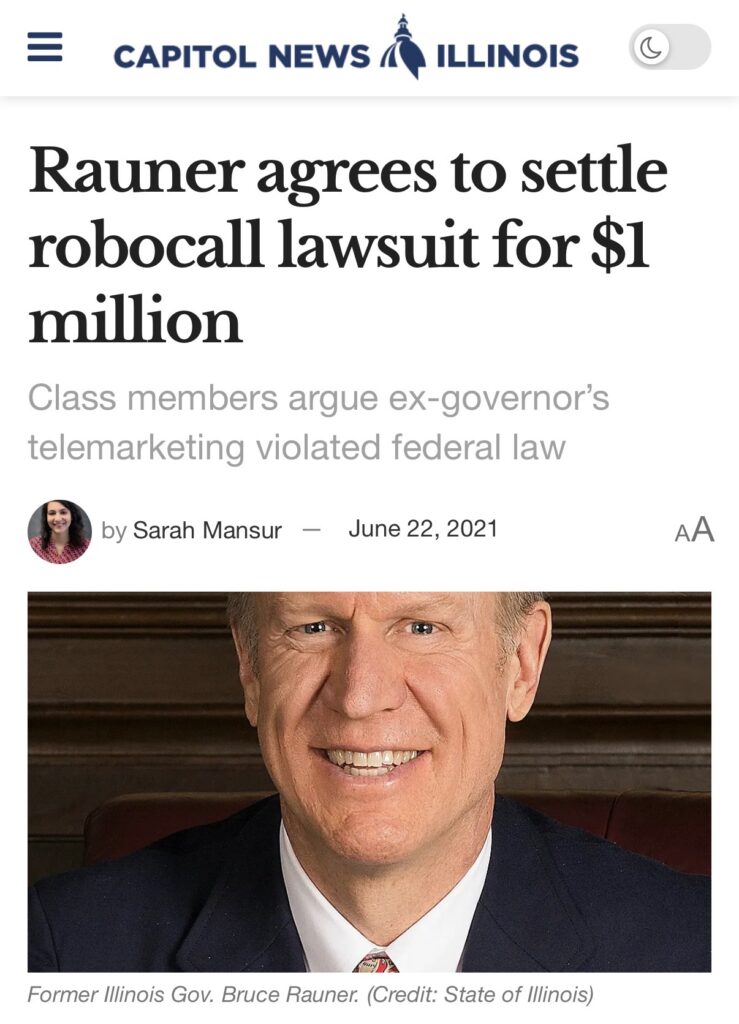
The suit alleged that Rauner’s campaign sent prerecorded voicemail robocalls to cell phones without consent, including messages urging support in the 2018 Republican primary. While Rauner and his campaign denied wrongdoing, the settlement stands as a clear warning to every political campaign operating in Illinois.
That warning makes Dabrowski’s misstep even more striking given who is advising him. Dabrowski’s top campaign advisor is Jeanne Ives, a longtime and outspoken political enemy of Bruce Rauner. Ives built her reputation opposing Rauner’s brand of establishment Republican politics, frequently criticizing his judgment, leadership, and campaign decisions. Yet now, the Dabrowski campaign finds itself ensnared in the very same legal problem that cost Rauner’s campaign $1 million.
Illinois law compounds the risk. The state’s Election Code (10 ILCS 5/9-9.5) requires political calls to identify the sponsoring committee and prohibits blocking caller ID. Violations are a Class B misdemeanor, punishable by up to six months in jail and fines up to $1,500.
The State Board of Elections may also impose civil penalties and refer cases for prosecution.
None of this law is new. Illinois last amended its political robocall disclosure statute in 2014, and the federal TCPA has been enforced for decades. Any serious statewide campaign – especially one claiming reform credentials – is expected to know these rules cold.
Illinois is infamous for federal scrutiny of its governors. Now, Dabrowski has placed himself on that radar. Launching a campaign by violating federal law – and repeating the same mistake that cost a political rival millions – is not reform. It is a warning sign.