

By Illinois Review
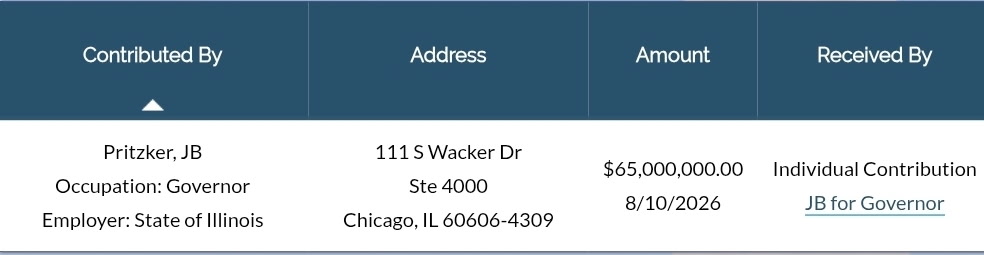
Illinois Gov. JB Pritzker has once again opened his billionaire checkbook, dumping another $65 million into his campaign for governor as his personal contributions to his three gubernatorial campaigns have now surpassed a staggering $326 million.
On August 10, Pritzker contributed $65 million to his campaign committee, leaving the Democratic governor with approximately $68 million cash on hand as he seeks a third term against Republican Darren Bailey.
The massive cash infusion comes as Pritzker continues raising his national profile and positioning himself as a potential Democratic presidential candidate in 2028.
But before Pritzker can seriously make the case for the White House, he needs a strong showing at home – and there are warning signs for the billionaire governor both in Illinois and nationally.
Since 2020, more than 500,000 residents have left Illinois, while more than 1,200 businesses have departed the state – an exodus that Republicans have repeatedly blamed on high taxes, burdensome regulations and policies enacted under Pritzker.
And now Pritzker faces another potentially damaging setback: the Chicago Bears appear increasingly poised to relocate their proposed new stadium development to Indiana.
Losing one of Illinois’ most iconic sports franchises across state lines would deal a crushing political blow to a governor attempting to build a record he can sell to Democratic presidential voters nationwide.
The problems extend beyond Illinois.
Despite Pritzker’s aggressive efforts to build a national profile, he remains stuck at just 2 percent in national polling among potential Democratic presidential candidates – placing him near the bottom of a crowded field of possible 2028 contenders.
That makes November particularly important.
A weak performance in heavily Democratic Illinois could raise further questions about Pritzker’s national viability. A decisive victory, however, would allow him to claim political momentum and provide a foundation of donors, operatives and allies for a potential presidential campaign.
And Pritzker appears willing to spend whatever it takes to secure one.
In 2018, Pritzker poured approximately $171.5 million of his own money into his first gubernatorial campaign, setting what was then a national record for self-funding a governor’s race.
Four years later, Pritzker again reached deep into his pockets, spending roughly $150 million during his reelection campaign against Bailey.
Pritzker then contributed another $25.5 million in late 2025 as he prepared for his third campaign, followed by the enormous $65 million contribution on August 10.
Altogether, Pritzker has now contributed more than $326 million of his personal fortune to his campaigns for governor – an extraordinary financial advantage unavailable to virtually any opponent he faces.
While most candidates must build donor networks and convince supporters to finance their campaigns, Pritzker can simply write another eight-figure check.
But Pritzker’s fortune cannot erase the political vulnerabilities confronting him.
Hundreds of thousands of residents have left Illinois. Businesses have followed. The Bears could be next. And despite years spent building a national profile, Pritzker remains stuck at just 2 percent in presidential polling.
For a governor with obvious White House ambitions, November is about more than winning a third term. Pritzker needs a commanding victory at home to make the case that he can win nationally.
After more than $326 million in personal campaign contributions, Pritzker has never lacked the money.
The question is whether voters will give him the political momentum his presidential ambitions require.