

By Mark Vargas, Editor-in-Chief & Opinion Contributor
For nearly eighteen years, one of the most significant documents from one of Illinois’ most consequential political corruption cases has remained hidden from the American people: the FBI FD-302 summarizing former President Barack Obama’s December 2008 interview in the Rod Blagojevich investigation.
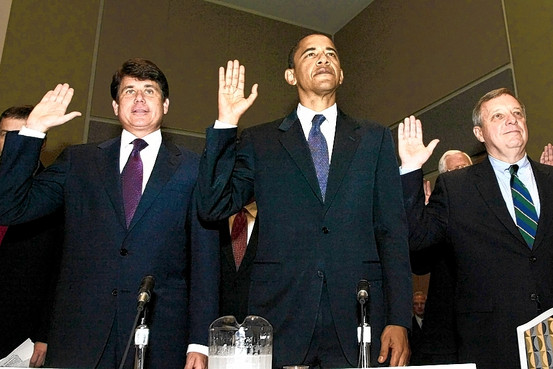
On December 9, 2008, more than two dozen FBI SWAT team members and a hostage negotiator arrived at the home of Illinois Governor Rod Blagojevich and arrested him on allegations that he was attempting to sell the U.S. Senate seat vacated by President-elect Barack Obama.
The first trial ended without a conviction on the Senate-seat allegation, leading to a second trial.
Blagojevich and his supporters – including this author – have long argued that prosecutors withheld exculpatory evidence, selectively presented recorded conversations, and built a misleading narrative that distorted what actually occurred.
The controversy surrounding the case did not end with the verdict. In 2015, the U.S. Court of Appeals overturned several of Blagojevich’s convictions, including the cenerpiece of their case – the so-called “sale of the Senate seat,” while leaving convictions related to political fundraising requests intact to preserve his 14-year prison sentence.
On February 18, 2020, President Donald Trump commuted Blagojevich’s sentence after he had served eight years in prison. On February 10, 2025, President Trump granted him a full presidential pardon.
Even today, the case continues to generate debate.
One question, however, has never been answered: Why didn’t the Obama administration – or later the Biden administration – ever release Obama’s FBI interview?
The Department of Justice should release it.
President Donald Trump’s administration has made government transparency a defining principle. From declassifying records related to the assassinations of President John F. Kennedy and Dr. Martin Luther King Jr. to releasing records concerning Crossfire Hurricane, intelligence abuses, and COVID-19, the administration has consistently argued that Americans are capable of evaluating the facts for themselves.
That same standard should apply here.
The Blagojevich investigation was no ordinary public corruption case. It centered on the appointment of the United States Senate seat Barack Obama vacated after winning the presidency.
It also marked what many Americans now view as one of the earliest examples of a politically charged federal prosecution involving some of the same law enforcement figures and institutions that would later become central to investigations targeting President Donald Trump.
The prosecution removed a sitting governor from office and became one of the most consequential political corruption cases in modern American history. Yet one of the investigation’s most important records remains locked away.
Why? Because there are two competing accounts of what happened.
During Blagojevich’s 2010 trial, labor leader Tom Balanoff testified that Obama personally called him on November 3, 2008, discussed Valerie Jarrett’s interest in the Senate appointment, and asked him to communicate Obama’s preferences to Blagojevich.
According to Balanoff, he did exactly that.
Those statements appeared difficult to reconcile with Obama’s public assurances following Blagojevich’s arrest. Obama stated that he had never spoken directly with Blagojevich about the Senate seat and said he was “confident that no representatives of mine would have any part of any deals related to this seat.”
His transition team similarly maintained there had been no inappropriate discussions or quid pro quo arrangements.
Blagojevich’s defense sought Obama’s FBI interview precisely because it could have clarified those apparent inconsistencies. Instead, the FD-302 remained hidden, fueling nearly two decades of unanswered questions.
As someone who worked closely with the Blagojevich family and advocated for clemency, I have long believed this prosecution deserves renewed scrutiny. Patrick Fitzgerald led the prosecution while Robert Mueller served as FBI Director.
Their decisions shaped a case that many Americans now view through a very different lens after years of politically charged investigations targeting President Donald Trump.
The continued concealment of Obama’s FBI interview naturally raises an obvious question: If the document fully supports the government’s version of events, why has it remained hidden for nearly eighteen years?
These competing accounts cannot both be correct.
Obama’s interview either corroborates the public narrative or raises legitimate questions about testimony presented at trial.
The Department of Justice already knows what the interview contains. The American people do not.
That raises perhaps the most important question of all. If Obama’s FBI interview materially contradicts testimony presented by the government’s own witness at trial, would that raise serious questions about the integrity of the prosecution?
If so, those questions deserve to be examined publicly.
If the FD-302 confirms Obama’s public statements, it will reinforce the government’s long-held position. If it reveals material inconsistencies with testimony presented at trial or the public record, those issues deserve to be examined openly.
It would also raise a fundamental question: Did the government knowingly present testimony it knew to be false?
If so, would that constitute prosecutorial misconduct, and could it provide grounds for the courts to revisit and reverse one of the most consequential political corruption prosecutions in modern American history?
Either outcome advances transparency and strengthens public confidence in our justice system.
That is precisely why the continued withholding of this document is so difficult to understand. Previous administrations chose not to release Obama’s FBI interview despite its historical significance.
Whatever the reason for those decisions, the current Department of Justice has an opportunity to take a different approach – one grounded in transparency rather than continued speculation.
President Trump has repeatedly argued that transparency is essential to restoring trust in government. Acting Attorney General Todd Blanche has likewise pledged to restore confidence in the Department of Justice by ensuring that justice is administered fairly and openly.
Releasing Obama’s FD-302 would be entirely consistent with those principles.
Whatever the interview ultimately reveals, the American people – not politicians, prosecutors, or commentators – should be allowed to examine the historical record and reach their own conclusions.
After nearly two decades, the time has come to close one of the final unresolved chapters of the Blagojevich case.
Release Obama’s FD-302.
End the speculation, and most importantly, let the facts speak for themselves.

By Illinois ReviewOne of the more ironic twists in recent Chicago political history is unfolding just four years after former Mayor Lori Lightfoot celebrated the approval of Bally's...
Read moreDetails