


By Illinois Review
The Democratic Socialists of America are no longer a fringe movement operating on the outskirts of Democratic politics.
Following Tuesday’s Democratic primary victories in New York City, they have become one of the party’s most influential forces – and Mayor Zohran Mamdani now stands as the clearest symbol of that transformation.
In a sweeping display of political power, candidates backed by Mamdani and the Democratic Socialists of America scored major victories across New York City’s congressional races, defeating establishment Democrats and further consolidating the socialist movement’s grip on the nation’s largest city.
For decades, Democratic Party leaders portrayed democratic socialism as a niche ideology with limited electoral appeal.
Mamdani’s own election as mayor in 2025 was already viewed as a watershed moment. At just 34 years old, he became the city’s first Muslim mayor, its first South Asian mayor, and the youngest person elected to the office in more than a century.
More importantly, he ran openly and unapologetically as a democratic socialist.
His campaign centered on rent freezes, free childcare, free public transportation, government-run grocery stores, a $30 minimum wage, and significantly higher taxes on wealthy individuals and corporations.
Rather than distancing himself from socialism, Mamdani embraced the label and turned it into a winning political brand.
Tuesday’s primary results suggest his victory was not an isolated event.
Mamdani-backed candidates delivered several of the night’s biggest upsets. Darializa Avila Chevalier, a self-described Democratic Socialist of America member and first-time candidate, defeated longtime Congressman Adriano Espaillat.
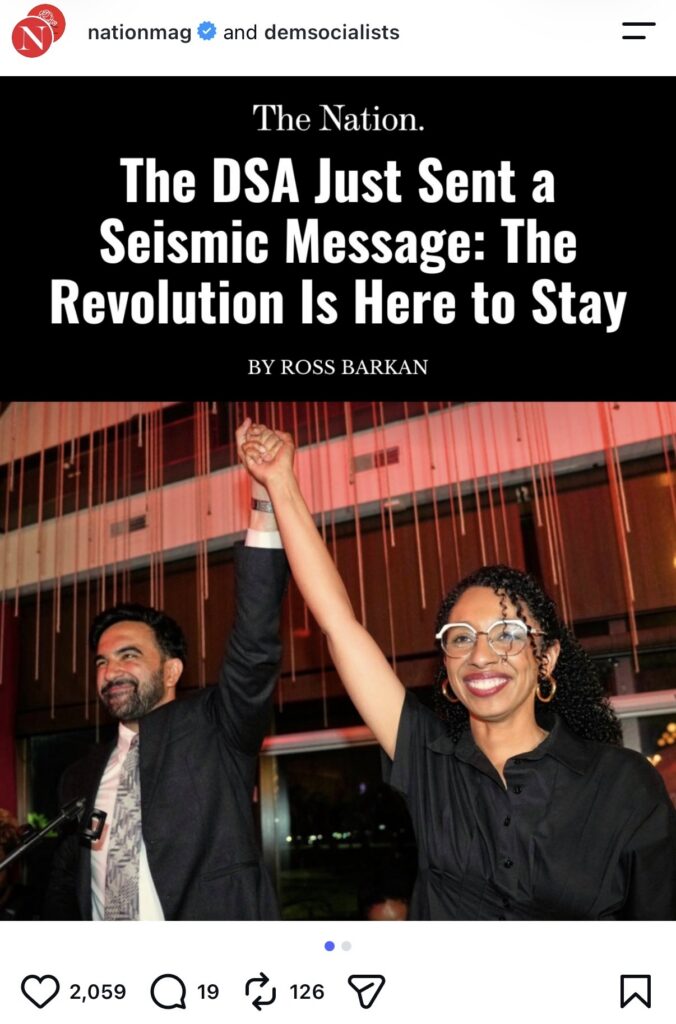
State Assemblywoman Claire Valdez, another DSA-backed candidate, captured an open congressional seat.
Former New York City Comptroller Brad Lander, a close Mamdani ally, defeated incumbent Congressman Dan Goldman.
Taken together, the victories represent more than individual races. They reflect the growing institutional power of the Democratic Party’s socialist wing.
The movement that once operated on the margins now possesses fundraising networks, grassroots organizing infrastructure, media influence, and a growing bench of elected officials.
What began as an insurgency has evolved into a governing coalition.
The policy agenda advanced by Mamdani and many of his allies marks a sharp departure from traditional Democratic politics. Many support abolishing ICE, dramatically restricting deportations, imposing new taxes on wealth and corporations, expanding government-run services, strengthening rent controls, reducing incarceration, and reshaping policing.
Several have openly embraced positions that would have been considered politically toxic within the Democratic Party just a decade ago.
Supporters argue these policies reflect the economic realities facing working-class Americans struggling with housing costs, inflation, and stagnant wages. Critics contend they represent an ideological shift that risks undermining public safety, economic growth, and fiscal stability.
Regardless of where voters stand on the debate, one fact is increasingly difficult to ignore: democratic socialists are winning elections.
For years, progressive activists argued that Democratic voters wanted a more aggressive left-wing agenda. The victories in New York suggest they may have been right – at least in some of the nation’s deepest-blue districts.
The broader question now facing Democrats is whether the party will continue moving toward the Mamdani model or whether moderates will eventually push back.
For the moment, however, the momentum belongs to the socialists.
And in America’s media capital, no figure embodies that momentum more than Zohran Mamdani – a young, democratic socialist whose rise increasingly reflects the direction of today’s Democratic Party.