

By Illinois Review
Illinois Gov. JB Pritzker is facing renewed scrutiny as a widening waste, fraud, and abuse controversy brings fresh attention to past conduct investigators once labeled a “scheme to defraud” taxpayers.
The renewed focus comes amid disclosures involving hundreds of millions – and billions – of Illinois taxpayer dollars tied to entities connected to the governor.
Public records show that a Pritzker-linked hotel in Chicago has received roughly $180 million in taxpayer-funded renovations, while 12 for-profit companies held in the governor’s so-called “blind trust” have collectively secured more than $20 billion in Illinois state contracts – all funded with taxpayer money – since he took office.
As those figures draw attention in Springfield, critics and watchdogs are revisiting a lesser-known but well-documented episode from Pritzker’s pre-governor days that raised serious questions about ethics and honesty.
The controversy, widely referred to as ‘Toiletgate,’ dates back to 2015. At the time, Pritzker and his wife, MK Pritzker, owned a vacant mansion on Chicago’s Gold Coast, adjacent to their primary residence. During renovations, five toilets were removed and plumbing lines were capped shortly before a property tax appeal was filed with Cook County.
Under county rules, a residence lacking basic utilities can be classified as “uninhabitable,” qualifying it for a sharply reduced assessment. The appeal resulted in the mansion’s assessed value dropping from approximately $6.3 million to about $1.1 million.
The reduction led to about $133,000 in property tax refunds for the years 2012 through 2014, along with roughly $199,000 in additional tax savings for 2015 and 2016. In total, the benefit to the Pritzker’s was approximately $331,000.
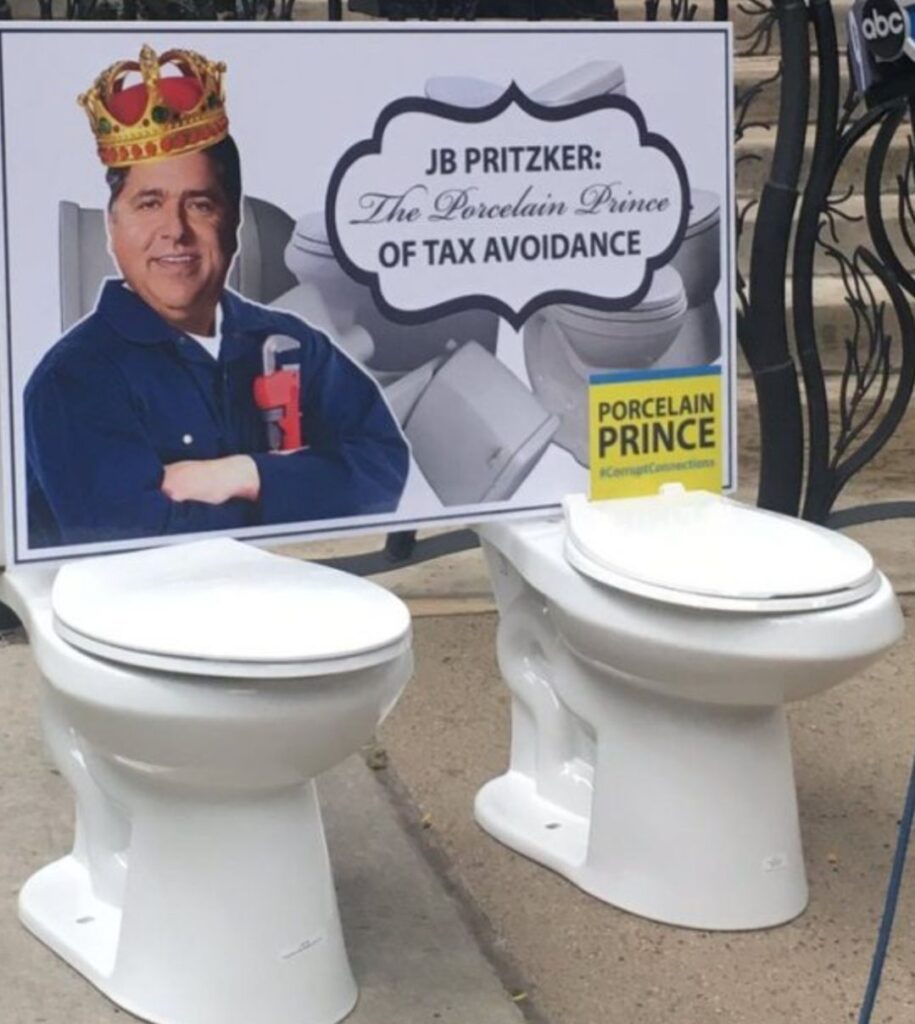
In September 2018, just weeks before the gubernatorial election, the Cook County Inspector General released a report examining the episode. The report described the actions as a “scheme to defraud” taxpayers and cited sworn affidavits and internal emails indicating that the toilets were removed specifically to support the tax appeal.
Investigators noted that the toilets were lined up in the garage during inspection and that at least one was later reinstalled.
Despite the findings, the issue did not prevent Pritzker from winning the governorship. Now, the governor’s financial arrangements are again under the microscope.
One focal point is the Hyatt Regency McCormick Place, which has received roughly $180 million in taxpayer-funded upgrades through public authorities associated with the McCormick Place convention complex.
Board members overseeing those authorities are appointed, in part, by the governor.
Separately, state records and watchdog analyses show that companies held within Pritzker’s blind trust have received more than $20 billion in state contracts since 2019. Those contracts are funded through state tax revenues and federal matching dollars.
Pritzker has consistently said the blind trust prevents conflicts of interest and that he is legally insulated from decisions involving those companies. Critics counter that the scale of taxpayer dollars involved raises legitimate concerns about transparency, oversight, and public trust.
As Illinois lawmakers debate reforms aimed at addressing waste and restoring confidence in state government, the resurfacing of Toiletgate underscores a broader question now confronting voters: whether past findings and present disclosures reveal a troubling pattern in how taxpayer money is handled at the highest levels of state government.