


By John F. Di Leo, Opinion Contributor
The Chicago Bears might be moving.
The state of Indiana passed an enabling act, months ago, establishing a framework to welcome the Bears across the state line into northwest Indiana – and the Bears’ board just passed a measure enabling it to work on site selection and other related steps in Hammond.
Some point out that this isn’t the same as breaking ground and starting construction. The dreamers who hope to keep the Bears in Chicago cling to every interpretation, imagining with starry eyes that the Bears would never leave.
And that’s the real lesson of this fiasco: the fact that in Illinois, the Powers That Be simply cannot imagine the Bears ever leaving.
Gentle Reader, in case you’re fortunate enough to be far away from this sad domain, here’s a brief summary of the situation:
The Decatur Staleys were founded in 1919, a three hour drive south of Chicago, but were renamed the Chicago Bears and moved north to Chicago almost immediately, playing most home games at Wrigley Field on Chicago’s north side for the next fifty years.
Then in 1971, the Bears moved a few miles south to Soldier Field, located in what is known as the Museum Campus, a small manmade peninsula just south of downtown, shared by the Field Museum, the Shedd Aquarium, and the Adler Planetarium.
Through different owners and different eras, the Bears have tried to leave Chicago a few times in the past, hoping to find a suburban site free of the many undeniable negatives of downtown Chicago. When one of Illinois’ great racetracks, Arlington Park in northwest suburban Arlington Heights, went out of business a few years ago, the Bears bought the property, hoping to build a new stadium there.
They have now spent the past five years working with multiple local and state governments, trying to determine the optimal choice between downtown Chicago, suburban Arlington Heights, or Hammond, Indiana.
All parties in Indiana – city, county and state – have reportedly been cooperative and generous; the politicians of Chicago and Springfield, on the other hand, have been anything but.
It’s not shocking that a business is considering moving its headquarters. This happens all the time, all over the country.
Corporate headquarters move to other cities or states. Restaurants and department stores move across town. A large company might split up its unified complex, putting corporate in a busy downtown, moving production facilities to a suburban industrial park, setting up a sales and marketing office in yet a third location.
For a business to stay in the same location for fifty years, let alone a hundred or more, is the rarity.
There’s nothing odd about a company weighing its options and deciding to move.
But what is odd is the way the Chicago Bears’ potential move has dominated the headlines for years now.
As a sports team, the general public feels they have some degree of ownership; if not of the team itself, then of its spirit. Chicago Bears fans care about where “their” team is based, where it practices, where it plays, where it calls home. For people who regularly attend the games, this makes some sense; for people who watch games on television, at home or at sports bars, it’s harder to see justification for making a big deal out of their location.
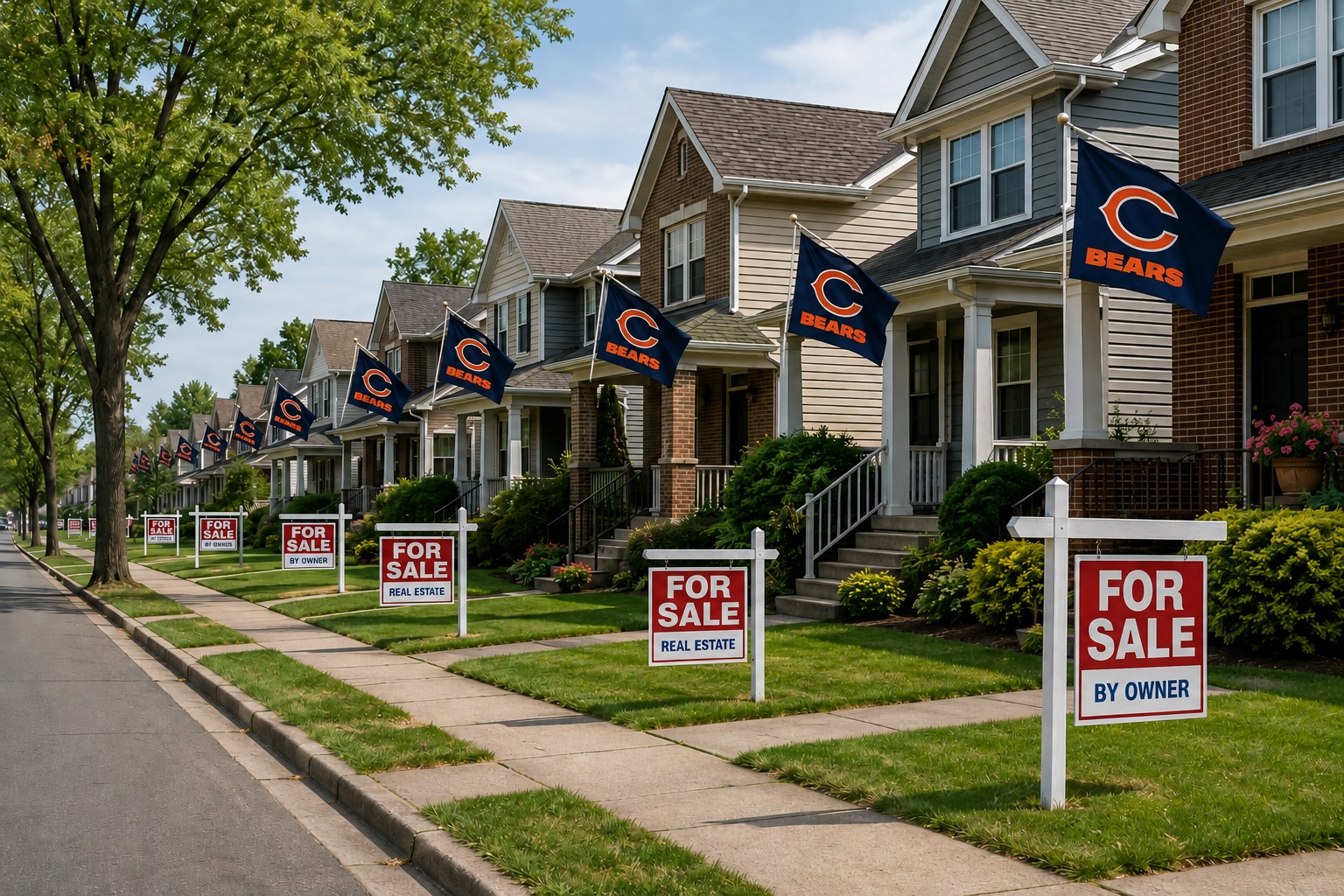
What’s more disturbing, however, is the fact that the Bears are only one company among thousands that have fled Illinois for greener pastures in recent years, some just moving over the border to Wisconsin, Indiana, Iowa, or Missouri, others moving far away, to Tennessee, Texas, or Florida.
And most of these others don’t get any headlines at all. They’re smaller companies, less famous companies, so they don’t command the newsprint that a National Football League franchise commands.
But these other companies – truckers, investment firms, factories, distribution centers, you name it, that have left Illinois – have also caused a move of all the same kinds of benefits that the Bears’ move would cause and the politicians fear losing: all these other businesses paid property taxes and income taxes when they were here; now they’ll bring that revenue to another state. They employed dozens, or hundreds, or thousands of workers when they were here – some white collar, some blue, some grey – and now they’ll provide those jobs elsewhere.
They brought third party support with them too, harder to describe but just as important: the restaurants and conference hotels that benefit from the outside sales reps who call on them, the landscapers and builders and facility staffs that care for the buildings, and all the dry cleaners and restaurants, theatres and shopping malls, that are frequented by the companies’ employees and their families.
The direct business that a company brings to its community is obvious and easily trackable; all the indirect business that it brings is no less real, but usually harder to quantify.
Sure, Illinois is right to be concerned about the potential loss of the Bears, but why on earth wasn’t Illinois concerned about all those other thousands of business departures in recent years as well?
Why didn’t Governor Pritzker, County Board President Preckwinkle, Mayor Johnson, and so many others start sounding an alarm, years ago, that the taxpayers and job creators of their state have been fleeing at a record pace? Republican candidates have warned about it; the Democrats in office haven’t seemed to care.
And why are they leaving? The state’s Democratic politicians will tell you it’s because they all want special deals, special tax packages, special perks – but for the most part, these companies aren’t asking for, or obtaining from others, any special privileges at all. It’s the normal statistics that are driving companies out of Illinois in droves.
Illinois ranks with New York and California as having the highest total tax burden in the country, for both the businesses and the individuals they employ. Why stay?
Illinois has the worst traffic congestion, and has roads most frequently narrowed and made dangerous by long-term road construction, making commutes longer, more expensive, and more miserable. Why stay?
Illinois has among the nation’s worst murder rates, rape rates, carjacking rates, burglary rates. Does a company want to inflict such an environment on its vendors, its customers, its families? Not if they can help it. Why stay?
When you put all these dangers together, what else do they do, by extension? They give you among the highest auto insurance rates, homeowners’ insurance rates, business insurance rates, and security costs. Why stay?
There are good reasons why these thousands of businesses have fled, and why their tens of thousands of employees and their families have left as well, and are sure to continue to, as the Pritzker, Johnson, and Preckwinkle regimes march on.
The current leadership of Illinois – especially that of Chicago – has no intention of changing any of the conditions that have caused all these problems. In fact, because of these and other underlying issues, everyone knows that conditions in Illinois will only get worse. So, as bad as it was five years ago, and as much worse as it is today, we know that it will still be even worse five years from now. And ten. And twenty.
Whether a businessman is running a football team or a factory, he can tell whether a jurisdiction’s trajectory is inclined toward improvement or worsening.
Illinois is bankrupt and getting worse, with a shrinking tax base and an exploding public pension crisis that Illinois’ all-Democrat leadership has refused to address for years.
Illinois is crime-ridden and getting worse, refusing to prosecute most criminals and refusing to imprison most of the few they do prosecute, which floods the region with recidivist criminals, unnecessarily endangering residents throughout the area.
Illinois is squeezed dry, and getting worse, with a welfare state that grows larger all the time, as employers are driven out and unemployable foreign indigents are welcomed, under the suicidal
(and illegal) policy of a “sanctuary” city, county and state.
We don’t know, at this point, where the Bears will end up. In the next few years, they may be playing, winning, and losing in Chicago, the suburbs, or northwest Indiana; nobody knows for sure.
But what is certain is that the rest of us will be losing, more often than not, in a crime-ridden, bureaucratic, overpriced hellhole of a state that gives us all more and more reasons, every day, to plan our escapes.
We wish our beloved Bears the best of luck, but the rest of us need some luck as well, as long as we’re stuck in Illinois.
Copyright 2026 John F. Di Leo

By Illinois ReviewFormer Illinois House Republican Leader Jim Durkin, who recently endorsed Democratic Gov. JB Pritzker over Republican gubernatorial nominee Darren Bailey, allegedly launched an unprovoked, profanity-laced verbal...
Read moreDetails