


By Illinois Review
New data from the March 17, 2026 Illinois primary is sending shockwaves through Republican circles, as turnout numbers reveal a dramatic collapse in GOP participation – and a warning sign with long-term consequences for the party.
The headline number is stark: only about 33 percent of Illinois Republicans’ own modeled voter base showed up to vote.
According to voter data, just 561,000 Republicans cast ballots in the primary. Campaign voter models estimate there are approximately 1.69 million Republican-leaning voters in Illinois.
That means two out of every three Republican voters stayed home.
By comparison, Republicans turned out about 47 percent of their base in 2022 – marking a 14-point drop in enthusiasm in just four years.
Meanwhile, Democrats moved in the opposite direction.
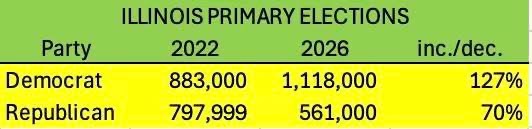
Democrats cast approximately 1,118,000 ballots in 2026, a 27 percent increase over their 2022 total of 883,000. Using the same modeling, Democrats turned out roughly 34.6 percent of their base – nearly identical intensity to Republicans, but from a significantly larger pool of voters.
That difference translated into a massive raw vote advantage.
Despite total statewide turnout remaining virtually unchanged at around 1.68 million ballots, Democrats expanded their share of the electorate to roughly two-thirds of all primary voters.
Republicans accounted for just one-third.
In 2022, the parties were nearly even. In 2026, the gap widened dramatically.
Political observers say the numbers reflect a clear partisan turnout shift – one that could have serious implications if it continues into the general election.
“This is how you lose a state for a generation,” a Republican operative said. “If only one-third of your own base is showing up, you’re not competing – you’re conceding ground.”
The turnout gap was visible across Illinois, including in key counties where Democrats significantly outpaced Republican participation.
Democrats also built a substantial advantage through early and mail-in voting, banking votes before Election Day while Republican participation lagged behind.
The concern among grassroots activists is not limited to a single election cycle. Primary turnout often serves as a leading indicator of general election strength. A disengaged base can weaken candidate recruitment, fundraising, and voter outreach – all before the fall campaign even begins.
Illinois Republicans already face steep challenges, including entrenched Democratic supermajorities in Springfield and Gov. JB Pritzker’s well-funded political operation.
Without a significant increase in voter engagement, those advantages will only grow. If the current trajectory holds, Republicans risk being locked into a permanent super minority in Illinois.
For many within the party, the takeaway from the 2026 primary is clear – the biggest threat isn’t just Democratic strength.
It’s Republican absence.