
By Illinois Review
Independent journalist Nick Shirley has become a significant thorn in the side of government waste and fraud – and California Democrats now appear determined to stop him.
At the center of the controversy is Assembly Bill 2624, authored by Democrat Assembly member Mia Bonta. While supporters frame the bill as protecting workers at “immigration support services” organizations from harassment, critics warn it could criminalize legitimate investigative journalism and shield taxpayer-funded programs from public scrutiny.
The bill advanced out of the Assembly Judiciary Committee on April 13, 2026, in an 11-2 vote, drawing sharp opposition from Republican lawmakers including Assembly member Carl DeMaio, who has openly labeled it the “Stop Nick Shirley Act.”
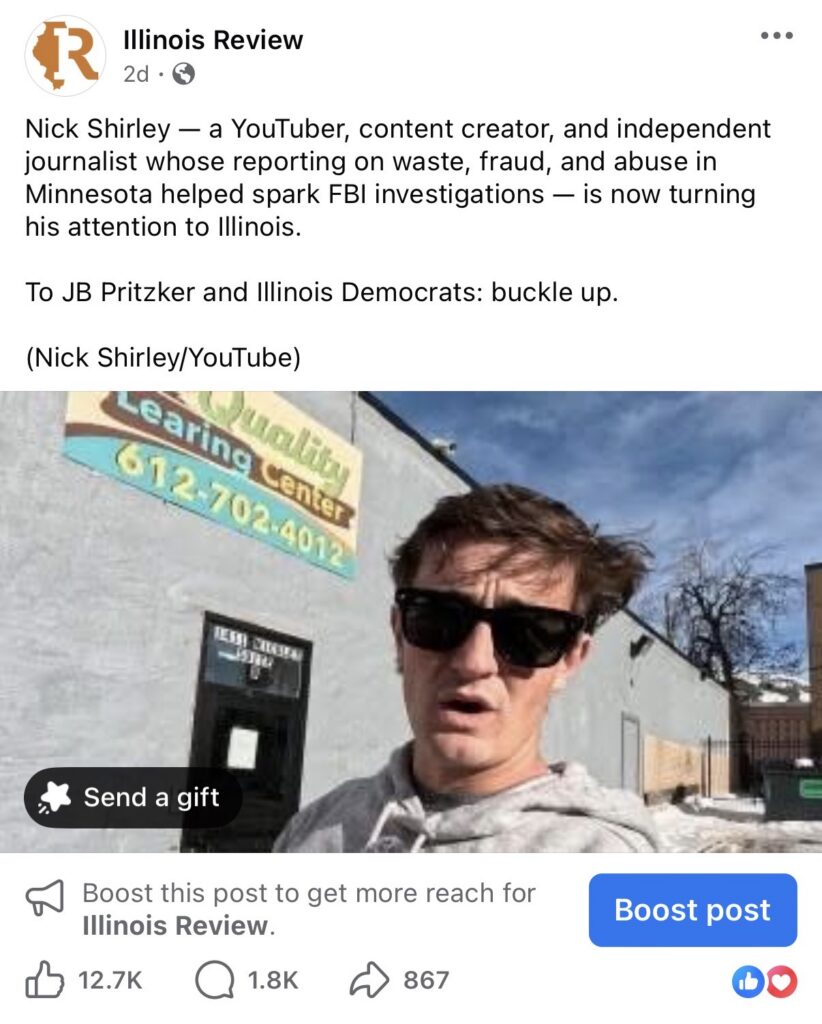
Shirley gained national attention with his undercover-style videos exposing apparent widespread waste and fraud in publicly funded programs, particularly in Minnesota. His reporting highlighted daycare centers that appeared empty or barely operational during business hours – despite receiving substantial taxpayer dollars – including facilities with misspelled signs such as the Somali-linked “Learing” Daycare centers.
Those videos helped spark investigations, funding reviews, and broader questions about oversight in programs meant to support children and vulnerable families. Instead of addressing the underlying issues of accountability, critics say Democrats are advancing legislation that could punish those who bring them to light.
Under AB 2624, individuals could face misdemeanor charges, fines of up to $10,000 per violation, possible imprisonment, and forced content takedowns if their reporting is deemed to constitute “harassment.”
The bill creates new privacy protections allowing workers at certain immigration-related nonprofits and service providers to request removal of personal information or images posted online.
Opponents argue the language is overly vague and could be weaponized against journalists documenting activity at publicly funded facilities – even when filming from public spaces.
This raises serious First Amendment concerns, as it risks chilling protected speech on matters of clear public interest: how billions in taxpayer dollars are spent.
Shirley sounded the alarm in a widely shared post on X:
“California is trying to pass a bill that would criminalize investigative journalism with misdemeanors, $10,000 fines, imprisonment, and content takedown. The proposed bill is titled AB 2624 and was made after I exposed mass fraud by immigrant groups in America.”
He added: “Under AB 2624, government-funded entities like the Somali ‘Learing’ Daycare centers would be protected from being exposed if they operated inside California.”
The political optics have only intensified the backlash. Mia Bonta is married to California Attorney General Rob Bonta, whose office would play a role in enforcing laws like AB 2624. The family connection, combined with the bill’s timing right after Shirley’s high-profile exposés, has fueled accusations that it prioritizes shielding certain programs over transparency and accountability.
For taxpayers in Illinois – who have witnessed similar patterns of waste in social services and government programs under years of Democrat leadership – the issue hits close to home.
Shirley has reportedly hinted at turning his focus to Illinois next, a development that should put Gov. JB Pritzker and Springfield leaders on notice.
At its core, this fight is about transparency. Investigative journalists and citizen watchdogs play a vital role in exposing fraud, protecting public resources, and ensuring programs meant to help children and families actually deliver results. When facilities appear mismanaged or underutilized while drawing large taxpayer payouts, the public has a right to see the evidence.
Rather than strengthening audits and oversight, AB 2624 risks silencing scrutiny – potentially violating constitutional protections for news gathering and publishing on matters of public concern.
Nick Shirley’s reporting has already forced uncomfortable questions in Minnesota and beyond. If California’s bill becomes law and he shifts his lens to Illinois, many more revelations could follow.
Taxpayers in every blue state deserve accountability, not new tools to hide the truth.