


By John F. Di Leo, Opinion Contributor
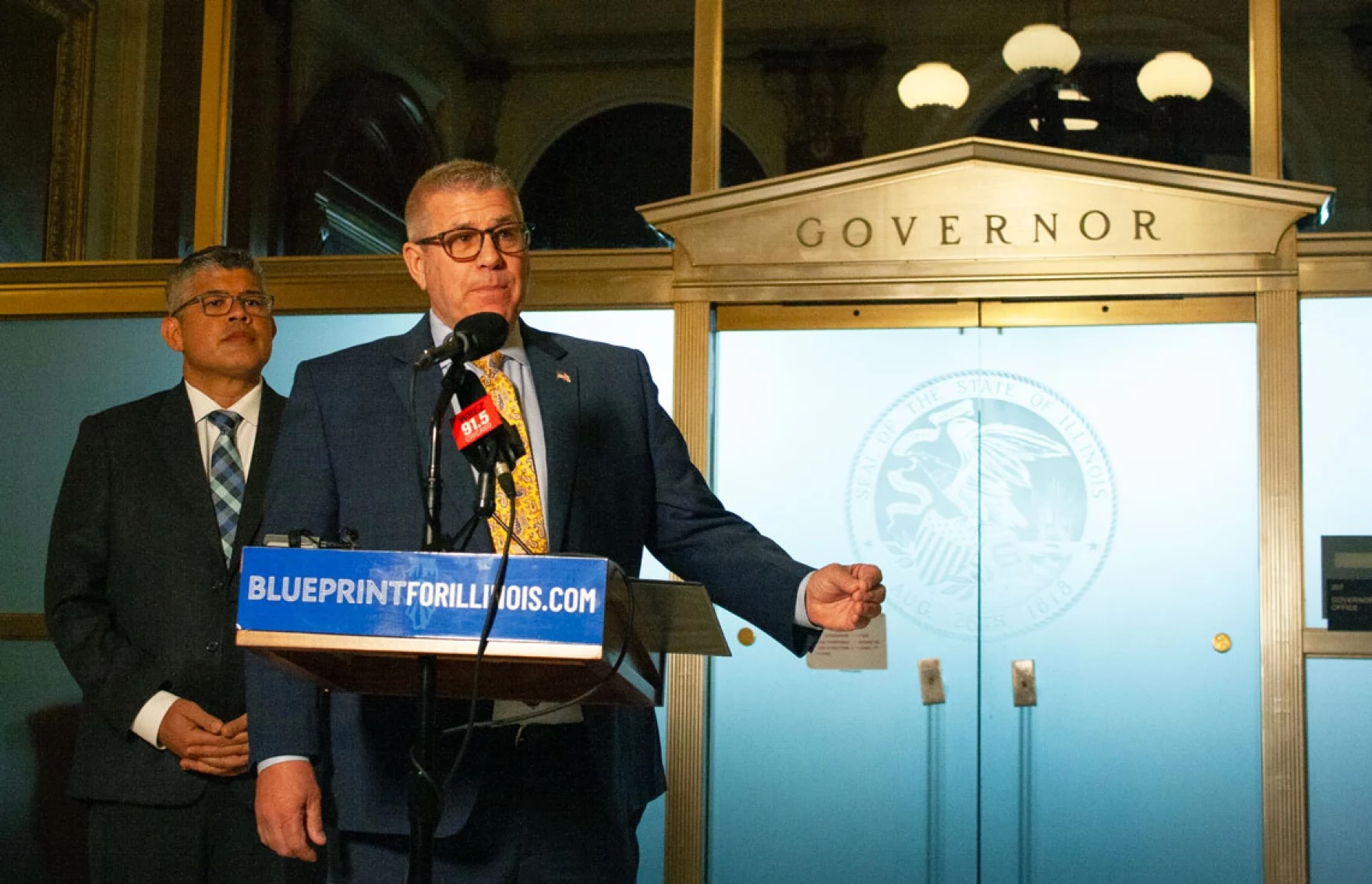
In the 2026 Illinois Republican primary, downstate businessman/politician Darren Bailey was nominated to face incumbent Governor J.B. Pritzker in November.
The descriptor is worth mentioning. Darren Bailey ran a successful family agricultural business and founded a local Christian school long before entering politics, eventually serving on his local school board and then serving as both a state rep and state senator.
This fact alone draws an important distinction between the parties, because (in Illinois especially), it’s astonishing how many Democrats have never worked in the private sector at all.
Democrat politicians tend to work for the government their entire lives, as teachers or bureaucrats, then as legislative aides, then finally as elected politicians themselves.
It is only the Republican party where we tend to see candidates for public office who have first lived the kind of lives that their constituents live, as salesmen and engineers, doctors and lawyers, accountants and entrepreneurs, restauranteurs and manufacturers.
J.B. Pritzker is the exception among Democrat candidates, because he did come from the private sector, in a way, but as an heir to the Marmon Group and Hyatt Hotels family conglomerate, his background is even less relatable to the average constituent than the typical machine politician’s.
At first glance, Darren Bailey’s most serious shortcoming as a political candidate is geographical: he’s running as a Republican in Illinois. And even worse, he’s running as a downstate Republican, encumbered by a downstate accent that can’t be disguised.
The vast majority of the state of Illinois is rural and agricultural; it’s Republican territory that primarily identifies well with Mr. Bailey. But unfortunately for him (and arguably, for us all), the majority of voters live north of I-80, in an urban and suburban area where a southern accent feels like a foreign tongue. Despite being a lifelong Illinoisan, to the eyes and ears of a Chicagoan, Mr. Bailey seems like a carpetbagger from Mississippi.
But is that really a big problem? It shouldn’t be. Illinois has voted for downstaters for statewide office before; Democrat Paul Simon came out of Troy, Republican Jim Edgar came from Charleston. Bailey’s home region of Effingham shouldn’t be a dealbreaker for the general election.
In fact, Bailey’s real demographic problems are twofold:
First, hundreds of thousands of Republicans have fled Illinois over the past generation, so both his potential donor pool and his potential voter base have been diminished as former Illinois Republicans became current Texas Republicans, Florida Republicans, and Tennessee Republicans. It is a bit more difficult a state for Republicans than it was in the days of Jim Thompson and Jim Edgar.
And Second, the Republicans who remain in Illinois – those who haven’t fled yet – are likely to have given up on their chances years ago, making them unlikely to show up to vote, even though they remain eligible. This, frankly, is the biggest challenge that Darren Bailey (and the entire GOP slate) will face this November: the fact that some percentage of actual potential voters simply won’t bother to participate, ceding the election to the opposition.
In the 2024 presidential election, Kamala Harris beat Donald Trump in Illinois by about 54 to 43.
Yes, that makes Illinois a “blue state.”
But there are degrees to such things:
Illinois is far closer to a swing state than dozens of others are. Look at the final results in 2024: Indiana went 59-40 for Trump; Kentucky went 64-34 for Trump. Massachusetts went 61-36 for Harris; California went 58-38 for Harris.
By comparison to those landslide states, Illinois’ 54/43 breakdown is just “leans Democrat,” a far cry from “guaranteed Democrat.”
The fact is, an electoral breakdown isn’t really a fixed quantity in the same way that the press presents it. Voters can be won over with a good campaign, with the right issues, with the better commercials, or with a personal touch that builds a connection. And turnout matters more than anything else.
In Illinois, virtually every issue – taken one by one – works against the incumbent Democrats. The Democrats’ approach to education, crime, and unemployment is a failure. The Democrats’ views on the welfare state, the melting pot, and virtually all the social issues, are contrary to the views of the general public.
Ask individual Illinoisans what they think of their property taxes and their tollways; ask if they’re happy about the schools, the crime rate, and the pension crisis, and they will tell you every one of them is awful and needs to be fixed.
But then do they vote against the Democrats who are directly responsible for all these disasters?
No. At least, not enough of them.
Once a state throws off the label of “swing” and gets itself considered a “safe” state for one side or the other, a certain percentage of the electorate just gives up. Oh, they’ll vote in presidential years, perhaps, but they just assume it isn’t worth the bother in non-presidential years.
Of course this isn’t true; it is always worth the bother, but they may not realize it.
And that’s what turns this hopelessness into a self-fulfilling prophesy.
If it really were a 54% Democrat / 43% Republican state, with 100% turnout in every election and a perfectly equal distribution in all jurisdictions, then yes, there would be no point in the minority even trying.
But that’s not the way it is.
In reality, elections aren’t about the breakdown of 100% of the people; they’re about the breakdown of 100% of the people who volunteer, who talk about the campaign, who donate, and who actually show up to vote.
Talk down one side, and that side will get fewer volunteers and donations, resulting in fewer votes. But resist the temptation of pessimism; resist the hopelessness – and the real final numbers will change for the better.
In the interest of relatively round numbers, let’s imagine a jurisdiction that’s 55% Democrat and 45% Republican. If 100% of that population votes, sure, that’s a 55-45 Democrat victory.
But 100% of the population NEVER votes.
Maybe 70% will. Maybe 50% will. Maybe 30%. Maybe 20%.
And maybe more of one group will vote than another.
In that same sample district – with a 55D-45R breakdown – if 80% of the Republicans vote and only 55% of the Democrats vote, the Republican candidate will actually win 55%/45%, proving that it was indeed winnable after all. It’s all about turnout.
And if those Republicans give up and don’t even bother, it’ll be a fatal blowout in the other direction: If 80% of the Democrats turn out and only 55% of the already weaker Republicans turn out, then the Democrats will enjoy a 64%/36% landslide.
All that with the same 55/45 population.
A winnable race looks like an insurmountable landslide when turnout is uneven.
Even more importantly – looking ahead – what does that do to future years?
The Republican who wins the race, or even the Republican who loses a close race 48 to 52, or 47 to 53, can honestly say it was winnable, and can build momentum for next time, with donations and volunteers and genuine chances for national support in the next cycle. After a few wins, he makes it look like a Republican district.
But the Republican who loses a race 36 to 64 will never be supported again. Both local and national funding sources will dry up, not just for that candidate but for the district, as people assume the district is simply unwinnable, and is therefore an utter waste of time to invest in.
So much of politics comes down to appearances and assumptions. Almost any district is winnable, especially when you consider the fact that even though the Democrats may have the institutional advantages, the Republicans have the issues, the statistics, and the future on their side.
Darren Bailey looks – on paper – like he has an uphill battle.
J.B. Pritzker has the advantages of incumbency and a huge hereditary fortune, not to mention the positive press of a major leftwing media hub.
But Darren Bailey has an advantage too: Illinois under Pritzker is a disaster area in every way, economically bankrupt and totally unaffordable for its residents. The people of Illinois know that everything needs to change; they just don’t believe that it can.
If Darren Bailey can successfully tie Illinois’ problems to his opponent – and how can he not? – then Darren Bailey just might be able to pull out a surprise this November.
For JB Pritzker to win reelection, he has to spend his millions on conning the public one more time.
But for Darren Bailey to win, he just has to find a way to communicate the truth.
Copyright 2026 John F. Di Leo

By Mark Vargas, Editor-in-Chief & Opinion ContributorIn 2019, behind closed doors with House Intelligence Committee investigators, Michael Cohen made a prediction about Roger Stone: Donald Trump would never...
Read moreDetails