


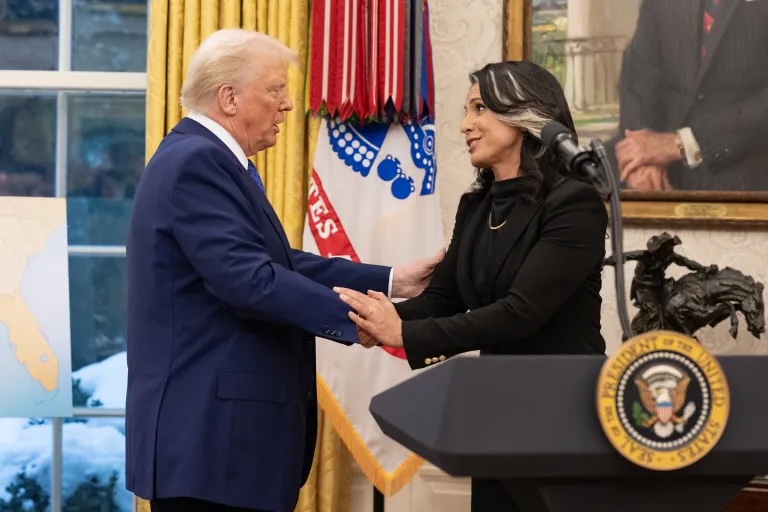
By Mark Vargas, Editor-in-Chief & Opinion Contributor
When Tulsi Gabbard was confirmed as Director of National Intelligence in February 2025, she inherited an intelligence community facing a historic crisis of confidence. Millions of Americans no longer trusted the agencies tasked with protecting national security.
Allegations of politicization, selective leaks, abuse of power, and intelligence weaponization had severely damaged public faith in institutions once viewed as untouchable.
Fifteen months later, Gabbard leaves office having done more to root out corruption and restore public trust inside the intelligence community than any Director of National Intelligence in modern American history.
And she accomplished it quietly.
Unlike so many officials in Washington who chase cable television appearances and media praise, Gabbard never sought the spotlight. She worked tirelessly behind the scenes, focused on reform instead of headlines.
Her mission was simple: restore integrity to America’s intelligence apparatus and return it to its core national security responsibilities.
She succeeded.
Under Gabbard’s leadership, the Office of the Director of National Intelligence underwent one of the most significant restructurings since its creation. Her “ODNI 2.0” reforms dramatically reduced bureaucracy, cut nearly $700 million in annual spending, and redirected personnel back into mission-focused intelligence operations.
Supporters viewed the reforms as long-overdue efforts to streamline bloated bureaucracies that had drifted from their core national security mission.
But Gabbard’s most consequential achievement was confronting what many Americans believed had become systemic weaponization inside the intelligence community.
For years, conservatives – including President Donald Trump – warned that intelligence agencies were increasingly being used to target political opponents, protect entrenched bureaucracies, and shape political narratives.
Previous administrations ignored those concerns – largely because many Americans believed the weaponization was intentional.
Gabbard confronted it directly.
She established the Director’s Initiative Group – a dedicated task force specifically created to investigate politicization, unauthorized leaks, abuses of power, and intelligence misconduct.
Security clearances were revoked for dozens of officials accused of improper conduct or politicized intelligence activity. Senior officials tied to controversial intelligence assessments were removed, while alleged leakers were referred for potential prosecution.
No previous DNI pursued accountability on this scale.
Equally important, Gabbard prioritized transparency. She oversaw major declassification efforts involving historical intelligence controversies, including documents tied to the Russia collusion investigation, Crossfire Hurricane, domestic surveillance concerns, and the long-secret JFK assassination files.
To millions of Americans who believed government institutions had hidden critical information for years, these actions represented something Washington rarely offers: honesty.
Critics predictably attacked her for challenging the permanent bureaucracy. But their outrage only reinforced why her reforms mattered. Tulsi Gabbard was willing to confront institutions that had grown far too comfortable operating without accountability.
Her resignation this spring to support her husband following his bone cancer diagnosis reflects the same values that defined her tenure – loyalty, sacrifice, and service.
Family came first. But make no mistake: Tulsi Gabbard’s public service career is far from over.
Over the past year, she has earned deep respect within the MAGA movement and among millions of Americans frustrated with government overreach and institutional corruption. She proved herself willing to challenge powerful interests when others would not.
In doing so, she earned the trust of grassroots conservatives across the country.
Many in the establishment will celebrate her departure, but Tulsi Gabbard leaves behind something far more important: a legacy of transparency, accountability, and renewed faith that America’s intelligence agencies can once again serve the American people – not the political establishment.
And something tells me Tulsi Gabbard is just getting started.